
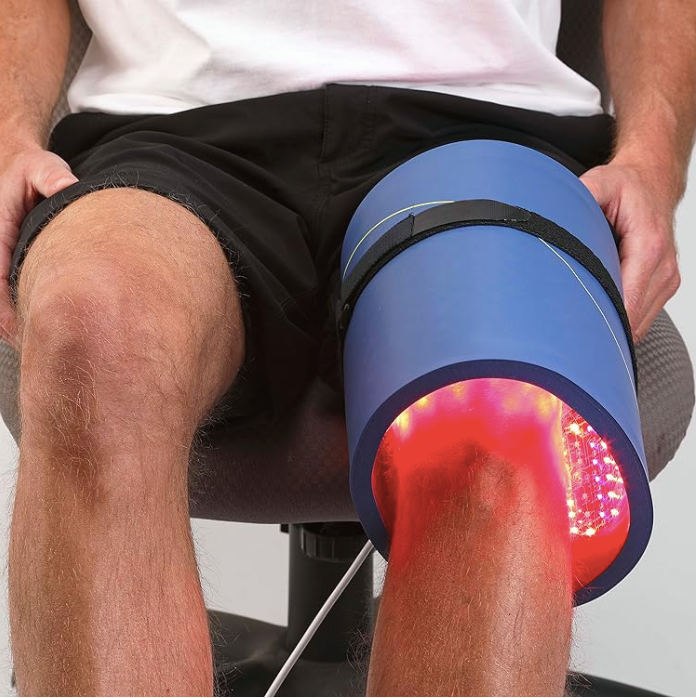
Featured image: Image from the Celluma collection.
The Celluma Journal · Updated
Clinical evidence has not established that red light therapy heals or rebuilds a torn meniscus. Some low-level laser studies have investigated pain and function alongside conservative care, but that is different from proving structural repair of a tear. The appropriate plan depends on the injury, symptoms and clinical assessment.
Why the type of tear matters
The menisci are structures within the knee that help distribute load and support joint function. Tears differ in location, pattern and cause. The American Academy of Orthopaedic Surgeons explains that blood supply varies across the meniscus and affects healing potential.
Knee pain alone does not confirm a meniscus tear. Examination and, when appropriate, imaging help establish what is happening. Other knee problems can produce pain, and an imaging finding must be interpreted alongside the person’s symptoms and function.
What the light-therapy studies have measured
A 2013 placebo-controlled study investigated low-level laser therapy in a selected group with meniscal pathology and assessed symptoms. More recently, a 2026 randomised study examined low-level laser therapy added to a rehabilitation programme, with pain and functional outcomes.
These studies provide a reason to investigate an adjunctive role for particular light protocols. They do not establish that Celluma repairs a torn meniscus, that an LED panel reproduces every laser protocol, or that pain improvement proves new cartilage has bridged a tear. The device, selection criteria and outcomes must stay visible when discussing the evidence.
Pain relief is valuable, but it is a different goal
Feeling more comfortable can help a person participate in an appropriate rehabilitation plan. It does not establish that an injured structure is ready for unrestricted loading. Decisions about exercise progression, return to sport or surgery should use the broader clinical picture.
The evidence does not establish that near-infrared light overcomes limited blood supply or predictably increases cartilage density after a few weeks. A cellular mechanism cannot supply that missing clinical proof.
What a sensible recovery plan can include
The AAOS guidance on meniscus repair explains why treatment selection depends on the tear and circumstances. Some people are managed without surgery; others need a surgical opinion. Rehabilitation, activity adjustment and symptom management should be matched to the individual.
Ask your treating clinician what activities are appropriate, which movements to avoid temporarily and what milestones should guide progress. Bracing, exercise progression and rehabilitation duration depend on the injury. Supplements have not been established as a way to make light therapy repair a meniscus.
Seek prompt assessment for a knee that locks, inability to bear weight or marked swelling after an injury. A home device should not delay evaluation of a mechanical problem or significant change in function.
Considering Celluma for a suitable pain goal
If your clinician considers a light-based pain approach appropriate, identify the exact device and intended use. A Celluma pain programme is intended for its specified pain indications; it has not been established as a meniscus-repair treatment. Follow its own instructions rather than converting the dose from a different research device.
Our guide to light dose and timing explains why more exposure is not automatically better. The FDA terminology guide explains why a general pain indication does not extend to every underlying injury.
For device operation and positioning questions, explore the Celluma range or speak with the team once the treatment purpose is clear. Keep the assessment and rehabilitation plan with the clinician managing the knee.
Frequently asked questions
Can LED therapy repair the meniscus white zone?
Structural repair through light treatment has not been established. Limited blood supply is a real clinical consideration, but a light mechanism does not prove that it can be overcome in a torn human meniscus.
Does less pain mean my tear has healed?
No. Pain and structural healing are different outcomes. Follow clinical guidance on loading and return to activity even if symptoms improve.
Can I avoid surgery by using Celluma?
Light treatment does not replace surgery when your clinical assessment shows it is needed. Many treatment decisions depend on tear pattern, symptoms and examination; discuss the appropriate options with your clinician.
What should I ask before adding light therapy?
Ask what outcome is being targeted, whether the device’s intended use fits that goal, how it will sit alongside rehabilitation and how progress will be assessed. Improvement in pain or function is useful, but it does not by itself show that the torn tissue has repaired.
Sources and further reading
- American Academy of Orthopaedic Surgeons: Meniscus tears
- American Academy of Orthopaedic Surgeons: Meniscus repair
- Malliaropoulos and colleagues: Placebo-controlled trial of low-level laser therapy for meniscal pathology (2013)
- Alsirhani: Randomised trial of low-level laser therapy alongside meniscus rehabilitation (2026)
- Celluma: Current user manuals by model and generation