

Is More Power Better for Red Light Therapy?
The Dose Truth Behind Collagen,
Wrinkles & Anti-Aging
High-power red light devices market themselves as more effective for collagen production, wrinkle treatment, and anti-aging. The biology says otherwise. Too much dose inhibits fibroblasts — the cells that build collagen and elastin. This guide explains the correct dose, the math behind it, and why proximity beats power every time.
More power is not better for red light therapy collagen and anti-aging results. Red light therapy follows the Arndt-Schulz Law — a biphasic dose-response curve. At the correct dose (2–6 J/cm² for skin collagen and wrinkle treatment), fibroblasts are optimally activated to produce collagen and elastin. At doses above the therapeutic window, cellular repair is inhibited — you get less result, not more. The metric that matters is fluence (J/cm²), not irradiance (mW/cm²).
Marketing for LED light therapy devices runs on a single number: mW/cm². More is better, the ads imply. Hundreds of milliwatts per square centimetre of red light power flooding your cells. The problem is that this number tells you the speed of delivery — not whether the delivery is correct for producing collagen, rebuilding elastin, or reducing wrinkles. Understanding one clinical equation changes how you evaluate every LED device on the market.
Irradiance vs Fluence — Two Different Things Sold as the Same Spec
Every peer-reviewed photobiomodulation study that confirms collagen production, wrinkle reduction, or elastin synthesis defines its outcomes by fluence — not irradiance. These are different measurements of different things, and conflating them is the foundation of most misleading LED device marketing.
The Dosimetry Formula — How to Calculate What You're Actually Getting
The relationship between irradiance, time, and fluence is straightforward. Understanding it immediately reveals whether a high-power device is actually delivering a better anti-aging dose — or just a faster one that exceeds the therapeutic window.
Example: 3.6 mW/cm² × 1,800 sec ÷ 1,000 = 6.5 J/cm² — optimal for skin anti-aging and wrinkle treatment
This is why a high-power device used for even 5 minutes can wildly exceed the therapeutic dose for collagen production — triggering biphasic inhibition — while a carefully calibrated device at lower irradiance used for 30 minutes lands precisely in the optimal window. Time in the therapeutic range, not power output, is the key variable.
The Arndt-Schulz Law — Why Too Much Dose Reduces Collagen and Elastin Results
The Arndt-Schulz Law is one of biology's foundational principles: small doses stimulate, large doses inhibit. It applies to photobiomodulation just as it applies to pharmacology. When researchers mapped red light's effect on fibroblast collagen production against dose, they found the characteristic U-shaped (biphasic) curve every time.
Optimal Fluence by Treatment Goal — Skin, Collagen & Anti-Aging
| Treatment Goal | Optimal Fluence (J/cm²) | Cellular Response | Celluma Delivers |
|---|---|---|---|
| Collagen Production (Type I & III) | 2–6 J/cm² | Peak fibroblast activation | ✓ 5.24–7.01 J/cm² |
| Elastin Synthesis | 2–6 J/cm² | Elastin gene upregulation | ✓ Within range |
| Wrinkle Reduction (Anti-aging) | 2–6 J/cm² | ECM remodelling + firming | ✓ 30-min protocol |
| Pain & Deeper Tissue Repair | 6–10 J/cm² | Mitochondrial activation at depth | ✓ Overlap range |
| Acne Treatment | 2–4 J/cm² | P. acnes destruction | ✓ 465nm mode |
| High-Power "5-min Blast" | 30–200+ J/cm² | Biphasic inhibition — collagen suppressed | Avoided by design |
Why Proximity Beats Power Every Time for Collagen and Wrinkle Results
The Inverse Square Law is the second reason high-power LED panels underperform their specifications. Double the distance between the LED panel and the skin, and irradiance at the skin surface falls to one quarter. A panel rated at 100 mW/cm² at 1cm delivers approximately 25 mW/cm² at 2cm, and 6 mW/cm² at 6cm.
High-power panels must be positioned at distance to avoid heat discomfort — often 15–50cm from the skin. This means the device's headline irradiance figure bears no relationship to what your fibroblasts actually receive. Proximity and contact are more important than power output for delivering the correct collagen-stimulating dose.
- Irradiance at skin surface: ~3–7 mW/cm²
- Session dose potentially sub-therapeutic or over-therapeutic
- Inconsistent dose — any movement changes delivery
- Cannot contour to face — gaps reduce dermal penetration
- Heat discomfort limits session length
- Full rated irradiance delivered at skin surface
- 5.24–7.01 J/cm² per 30-min session — within therapeutic window
- Consistent dose every session — same result every time
- Flexible panel contours to face — no gaps, no scatter
- Non-thermal — 30 min comfortable sessions daily
How Celluma Delivers the Correct Anti-Aging and Collagen Dose
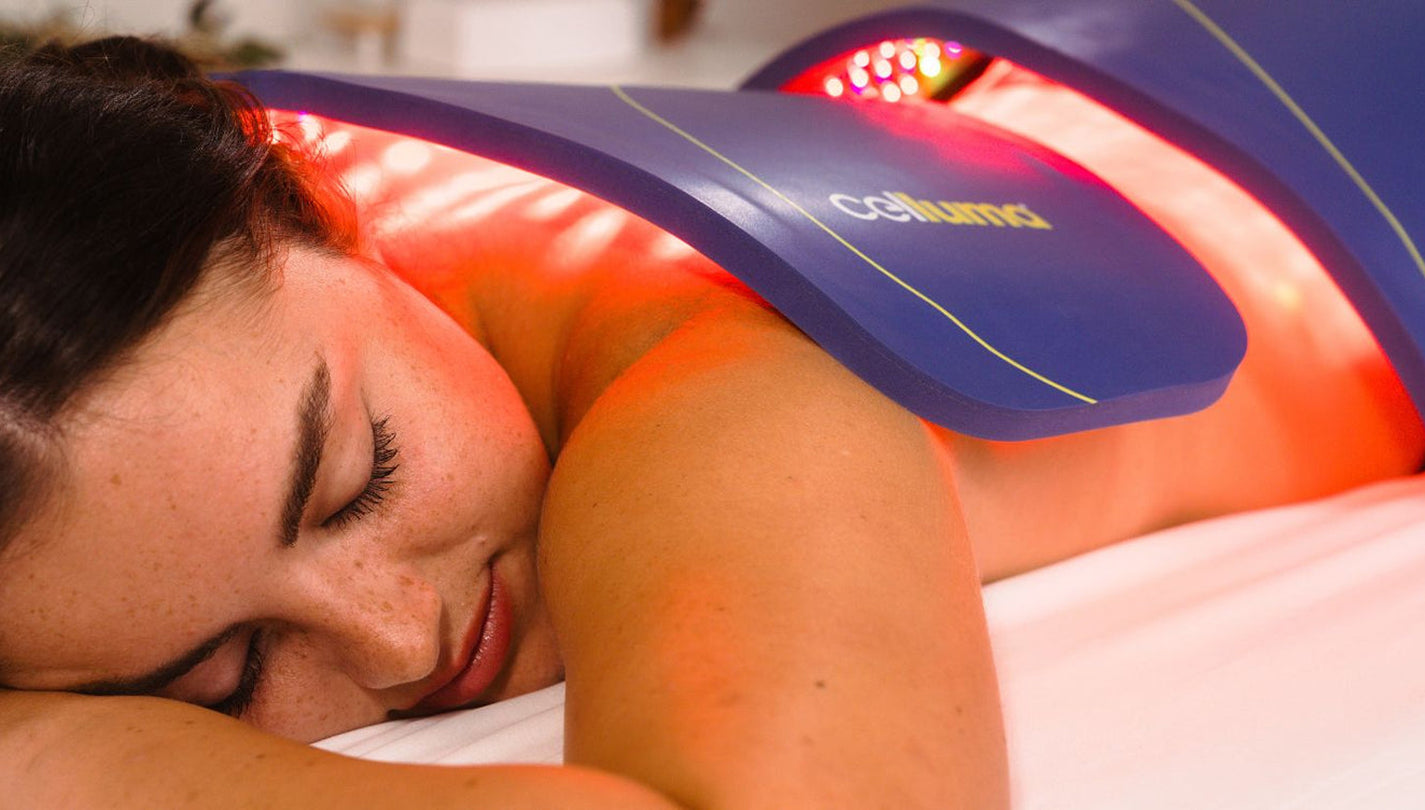
Celluma devices are engineered backwards from the therapeutic outcome — starting with the fluence range that clinical evidence confirms produces collagen synthesis, elastin production, and wrinkle reduction — then calibrating the irradiance and session duration to land in that window consistently, session after session.
30-min session
panel design
Auto shutoff
dosimetry
Which Celluma Device for Anti-Aging, Collagen & Wrinkles?
Frequently Asked Questions
No. Red light therapy follows the Arndt-Schulz biphasic dose-response curve. At the correct dose (2–6 J/cm² for skin), fibroblasts are optimally activated for collagen and elastin production. At doses above the therapeutic window (30+ J/cm²), cellular repair is inhibited — you get less anti-aging result, not more. High-power devices also lose most of their output to distance scatter via the Inverse Square Law.
The evidence-based therapeutic fluence for wrinkle reduction, collagen synthesis, and elastin production is 2–6 J/cm². Celluma's 30-minute anti-aging sessions deliver 5.24–7.01 J/cm² — consistently within this window. The formula: Fluence (J/cm²) = [Irradiance (mW/cm²) × Time (seconds)] ÷ 1,000.
Irradiance (mW/cm²) is the speed of light delivery — how much power hits each square centimetre per second. Fluence (J/cm²) is the total energy dose your cells receive over the full session. All clinical studies defining collagen, elastin, and wrinkle outcomes use fluence — not irradiance. Irradiance is the marketing number; fluence is the clinical number.
The biphasic dose response (Arndt-Schulz Law) means red light produces three outcomes by dose: sub-threshold (too little, minimal collagen response), therapeutic (correct dose, peak collagen and elastin production), and inhibitory (too much, fibroblast repair shuts down). Most high-power devices — used even briefly — deliver doses in the inhibitory range.
Celluma's flexible panel maintains zero-gap contact with the skin, so the full rated irradiance reaches dermal fibroblasts. High-power panels must be used at distance to avoid heat, losing most output to scatter (Inverse Square Law). Celluma also delivers a clinically calibrated 5.24–7.01 J/cm² per session — within the therapeutic window — versus high-power sessions that may exceed 30–200 J/cm², causing biphasic inhibition of collagen production.
30 minutes per session is the clinically validated Celluma protocol for anti-aging. At Celluma's irradiance level, 30 minutes delivers 5.24–7.01 J/cm² — the therapeutic window for collagen and elastin production. Longer is not better — exceeding the therapeutic window triggers biphasic inhibition. Consistent daily sessions compound over 8–12 weeks for measurable wrinkle and collagen results.
Celluma devices deliver 5.24–7.01 J/cm² per 30-minute session in anti-aging mode. This places the dose within the 2–6 J/cm² therapeutic window for skin collagen and elastin stimulation, with slight overlap into the 6–10 J/cm² range for pain — making it appropriate for multi-indication use while avoiding biphasic inhibition at the upper boundary.
At FDA-cleared device levels, thermal skin damage is not a concern. However, doses well above the therapeutic window (30+ J/cm²) cause biphasic inhibition — fibroblasts reduce collagen and elastin production rather than increase it. You don't get damaged skin — you get a worse anti-aging result. High-power devices used at close range or for extended periods routinely exceed this threshold.
Accuracy is the only metric.
Stop using light to see — use it to heal.
Explore FDA-cleared Celluma devices — clinically calibrated to the correct dose for collagen, elastin, and wrinkle results. Or WhatsApp our team for a recommendation.

Leave a comment
Laman ini dilindungi oleh hCaptcha dan tertakluk pada Dasar Privasi dan Terma Perkhidmatan hCaptcha.