
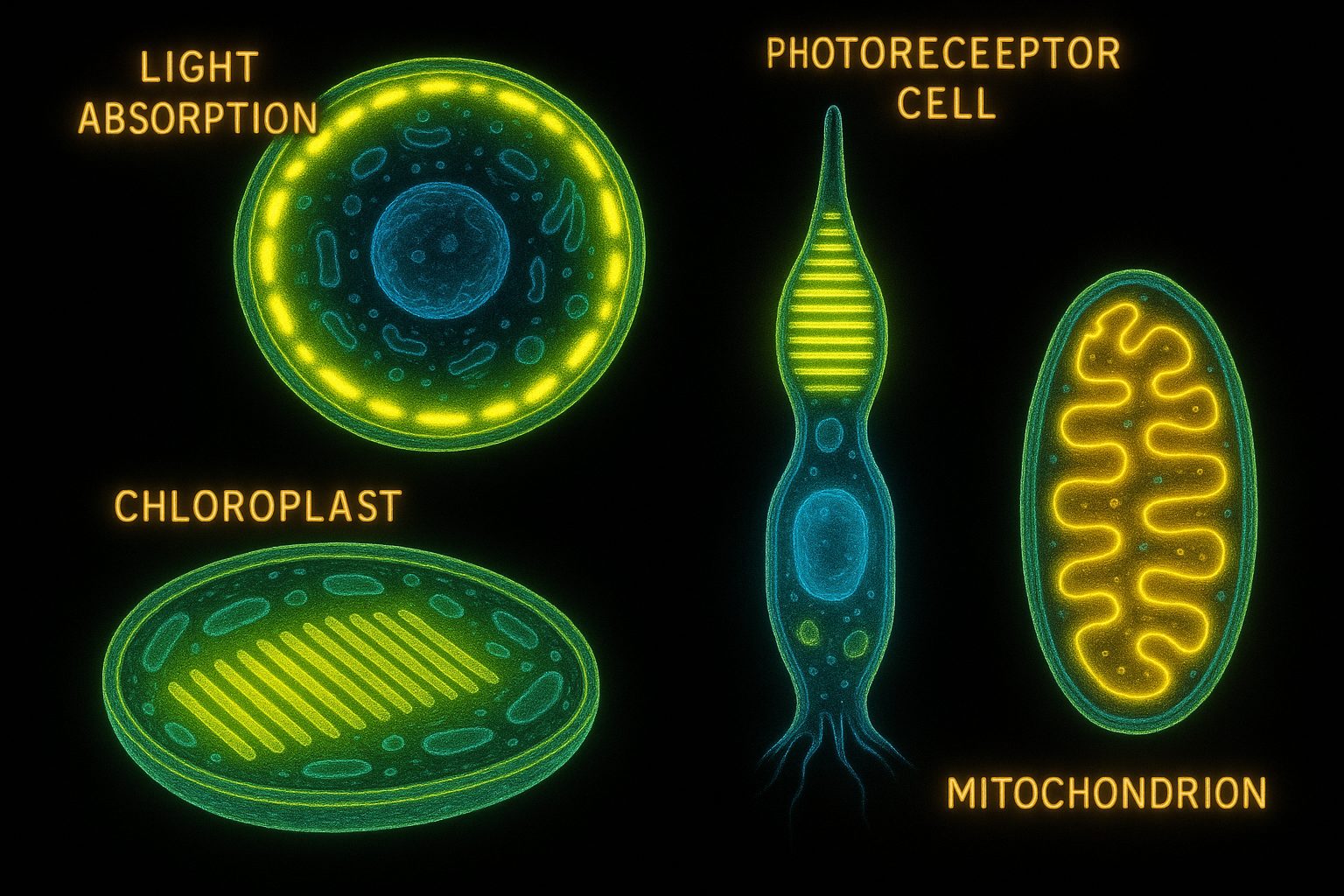
The Physics of Photobiomodulation:
Wavelength Precision & Chromophore Signalling
Wavelength is the lock. Photons are the key. Biological chromophores — like Cytochrome c Oxidase in the mitochondria — only absorb light within a precise wavelength range. A photon at the wrong nm passes through without any biological effect. This is why the difference between a therapeutic device and a decorative LED can be invisible to the eye but absolute at the cellular level. Wavelength precision is not a marketing preference — it is the governing principle of clinical success.
In the rigorous science of Photobiomodulation (PBM), wavelength precision is not a luxury — it is the absolute governing factor of clinical success. Using the “Lock and Key” model, we can accurately describe how specific photons interact with highly specialised biological targets inside the human body.
Simply shining a bright coloured light on skin does nothing. Cellular targets — known as chromophores — are extraordinarily selective. If the biological “lock” does not match the photonic “key,” the energy is scattered, reflected, or absorbed as heat without triggering any photochemical response.
✓ Key Fits Lock
Photon at exact wavelength (e.g. 640nm) is absorbed by Cytochrome c Oxidase. Energy converts to biochemical signal → ATP surge → collagen synthesis.
✗ Wrong Key
Photon at wrong wavelength (e.g. 660nm or 700nm) is scattered or reflected. No absorption. No biochemical response. Zero therapeutic effect regardless of brightness.
“Only a photon with a specific nanometre (nm) signature can be absorbed by a cellular chromophore. If the geometry of the light does not perfectly match the molecular lock, the energy is reflected or scattered — resulting in zero therapeutic biostimulation.”
The Beer-Lambert Law of Absorption
The necessity for exact wavelengths is grounded in biophysics. According to the Beer-Lambert Law, light absorption depends on three factors: the specific molar attenuation coefficient of the chromophore, the distance light must travel through tissue, and the concentration of target molecules. In plain terms: specific cells are mathematically programmed to absorb specific wavelengths — and the degree of absorption falls off predictably when the wavelength deviates from the peak.
Beer-Lambert Law — Optical Absorption Formula
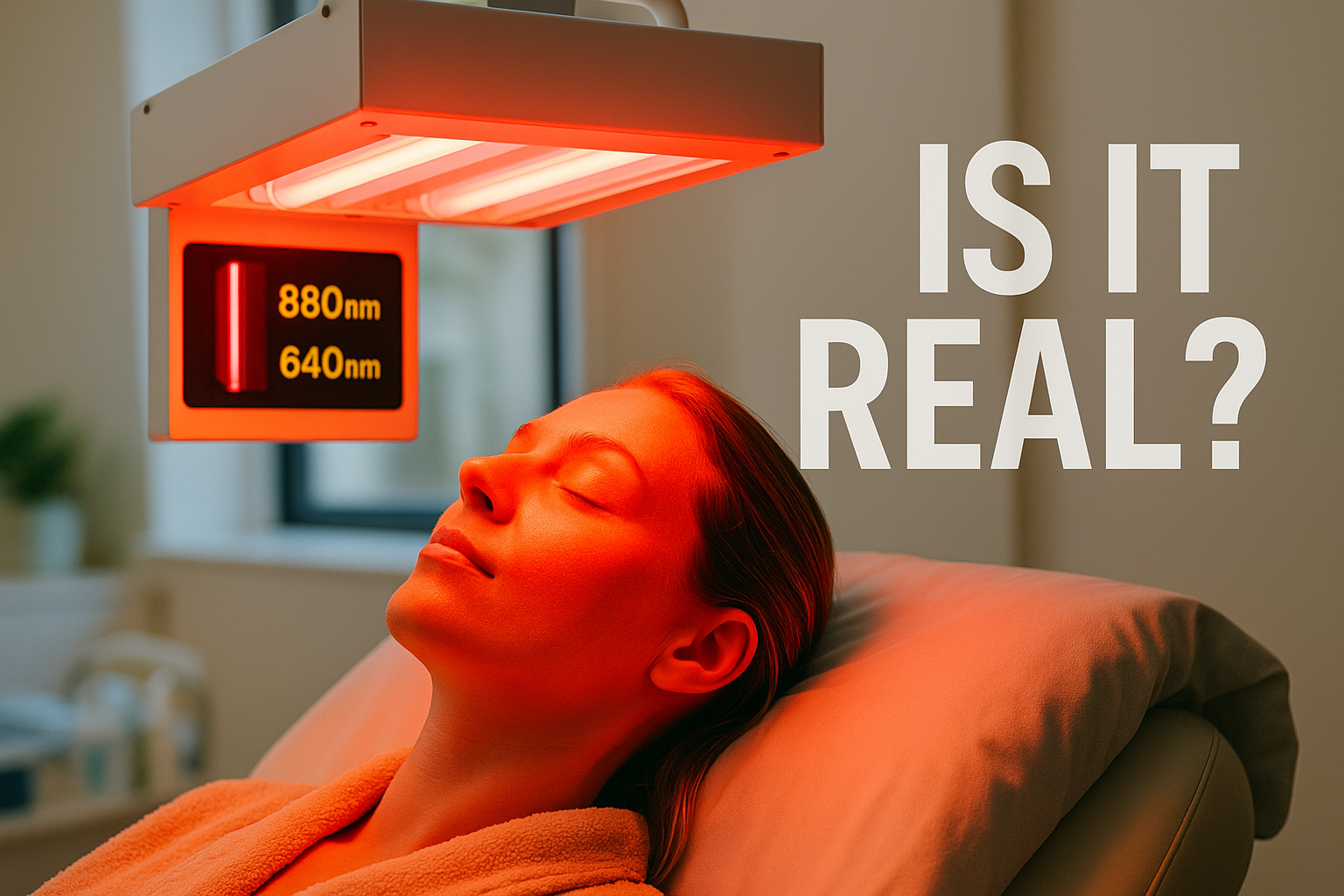
The ε term is the critical one: it is unique to each chromophore and defines exactly which wavelengths it absorbs efficiently. Cytochrome c Oxidase has peak ε values at approximately 640nm and 880nm. Porphyrins in P. acnes bacteria peak around 415nm and 630nm. Devices that do not operate at these peaks produce a low or zero ε response — meaning most of their light passes through unabsorbed.
The Action Spectra: Chromophore Targets by Wavelength
Different cellular structures contain unique chromophores. When a precisely calibrated wavelength hits these molecules, the optical energy is successfully converted into a biochemical signal — ATP production, bacterial destruction, or inflammation suppression depending on the target.
| Wavelength (nm) | Primary Chromophore | Biological Target | Clinical Outcome |
|---|---|---|---|
| 465nm Blue | Porphyrins | C. acnes Bacteria | Photodynamic bacterial destruction · Oil control |
| 640nm Red | Cytochrome c Oxidase | Dermal Fibroblasts | ATP surge · Collagen & elastin synthesis · Wrinkle reduction |
| 880nm Near-Infrared | CCO & Deep Tissue | Muscle, joints & macrophages | Inflammation reduction · Deep repair · Pain management |
The Risks of Unverified Consumer LED Devices
Not all devices emitting light are capable of producing therapeutic effects. Using inaccurate wavelengths, rigid panels that create air gaps, or consumer LEDs without independent clinical calibration carries real physiological risks that are underreported in the wellness industry.
Low-quality LEDs often generate excess ambient heat from high electrical wattage rather than calibrated photochemical delivery. While heat increases surface circulation, it does not trigger the photochemical regeneration required for collagen synthesis or bacterial destruction — and can aggravate heat-sensitive conditions including Melasma, Rosacea, and post-inflammatory hyperpigmentation.
This fundamental biological principle dictates that a clinically calibrated dose of light stimulates cellular healing, but an excessive or incorrect dose actively inhibits the very healing process it is intended to promote. Consumer devices delivering the wrong wavelength at high power may create an inhibitory over-dose — producing no benefit, or actively suppressing the cellular repair response.
Photons at non-optimal wavelengths are scattered through tissue rather than absorbed. This scatter increases the absorbed dose in unintended tissue layers and reduces delivery to the target chromophore depth. A device producing 660nm instead of 640nm does not just miss the target — it deposits energy in the wrong place at the wrong wavelength, producing neither a therapeutic stimulus nor the patient's desired outcome.
Decoding the Science
A chromophore is a light-sensitive molecule within a cell that absorbs specific wavelengths and converts the energy into a biological signal. The primary chromophore in photobiomodulation is Cytochrome c Oxidase (CCO) in the mitochondria, which absorbs 640nm red and 880nm near-infrared light to trigger ATP production. Porphyrins in P. acnes bacteria are the chromophore for 465nm blue light in acne treatment. Each chromophore only responds to its specific wavelength — other wavelengths pass through without effect.
Because biological chromophores have specific absorption peaks — they absorb maximum photon energy only within a narrow wavelength range. Even a 10–20nm deviation from Cytochrome c Oxidase's peak (640nm) significantly reduces the photochemical response. A photon at 660nm or 700nm looks identical to the human eye but produces a very different biological outcome. This is the Lock and Key model: only the exact nm signature fits the molecular receptor and triggers the therapeutic response.
The Beer-Lambert Law (A = εlc) states that light absorption depends on: ε (the molar attenuation coefficient — how strongly a chromophore absorbs a specific wavelength), l (path length through tissue), and c (chromophore concentration). The ε term is unique to each chromophore and defines exactly which wavelengths it absorbs efficiently. Devices not operating at the ε peak of their target chromophore produce minimal or zero absorption — and therefore no therapeutic effect.
The Biphasic Dose-Response (Arndt-Schulz Curve) is a fundamental PBM principle: a clinically calibrated dose of light stimulates healing, but an excessive or incorrect dose inhibits the same process. This is why cheap consumer devices can be counterproductive — they may deliver the wrong wavelength at high power, creating an inhibitory over-dose rather than a therapeutic stimulus. Medical-grade devices like Celluma are calibrated to deliver the precise fluence (J/cm²) that sits within the stimulation range, not the inhibition zone.
The Lock and Key model describes the specificity of photon-chromophore interactions. The biological “lock” is the chromophore (e.g. Cytochrome c Oxidase) with its specific absorption wavelength. The “key” is a photon at exactly the matching wavelength (e.g. 640nm). When the key fits, photon energy is absorbed and converted into ATP, collagen synthesis, or bacterial destruction. When the photon wavelength does not match the chromophore's ε peak, the energy scatters through without any biological effect — regardless of how bright the device appears.
Celluma uses three FDA-cleared wavelengths: 465nm blue targets porphyrins in C. acnes bacteria for photodynamic acne destruction (1–2mm depth); 640nm red targets Cytochrome c Oxidase in dermal fibroblast mitochondria for collagen and elastin synthesis (4–6mm depth); 880nm near-infrared targets CCO and deep tissue macrophages for inflammation reduction and pain management (6–10mm depth). Each wavelength has been independently reviewed by the FDA for its specific therapeutic indication.


Tinggalkan komentar
Situs ini dilindungi oleh hCaptcha dan berlaku Kebijakan Privasi serta Ketentuan Layanan hCaptcha.