
The Invisible Erosion:
How UV Quietly Dismantles Your Collagen
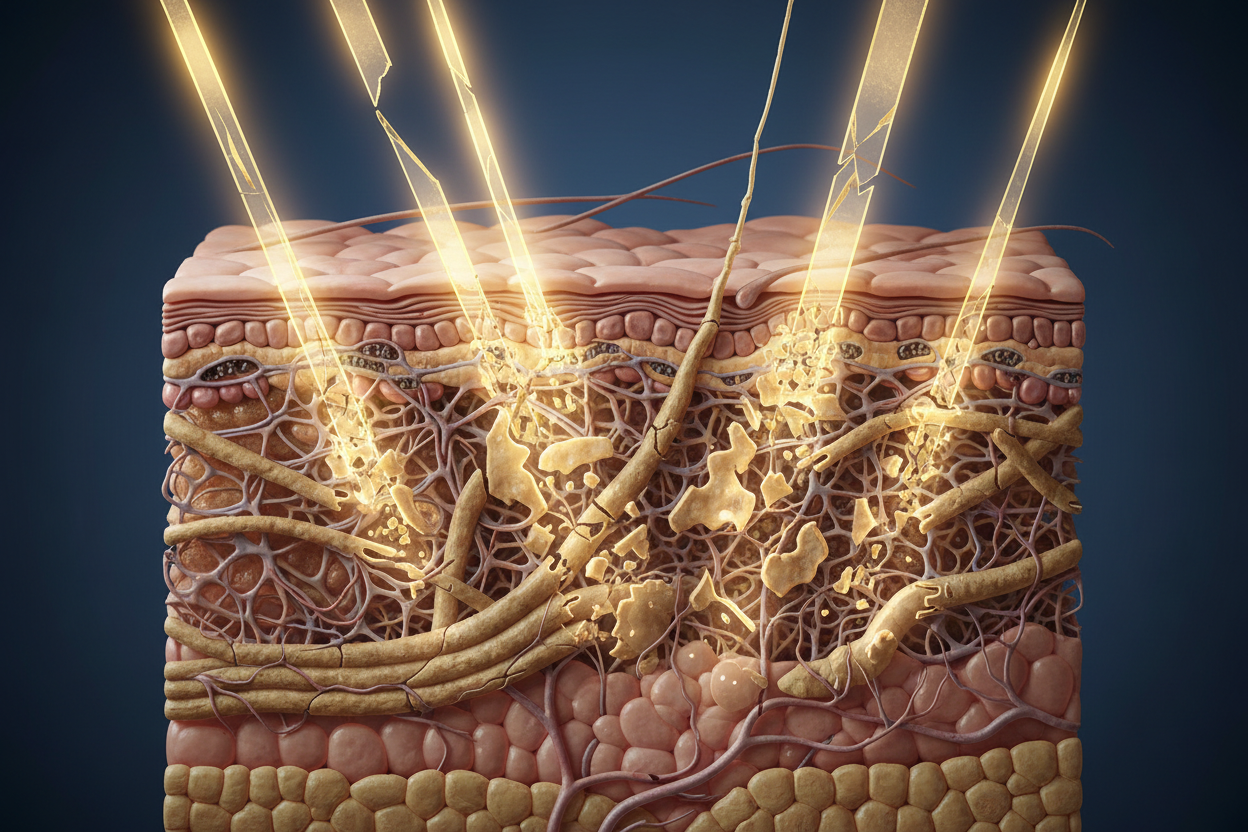
UV radiation doesn't just tan your skin — it issues a biological command to dissolve it. High-energy UV photons introduce Reactive Oxygen Species into the dermis and massively upregulate Matrix Metalloproteinase (MMP) enzymes that shred collagen faster than the body can replace it. In Singapore's extreme UV climate (UV Index 10–13 daily), this process is relentless without active protection. SPF 50+ stops ongoing destruction. Red light therapy (640nm) rebuilds what has already been lost.
While most see sunscreen merely as a barrier against surface burns, its true clinical value lies in protecting the Dermal Matrix. Beneath the surface, ultraviolet radiation acts as a powerful biological catalyst for extrinsic aging, triggering a cascade that actively dissolves the skin's structural scaffolding: Collagen Type I and III.
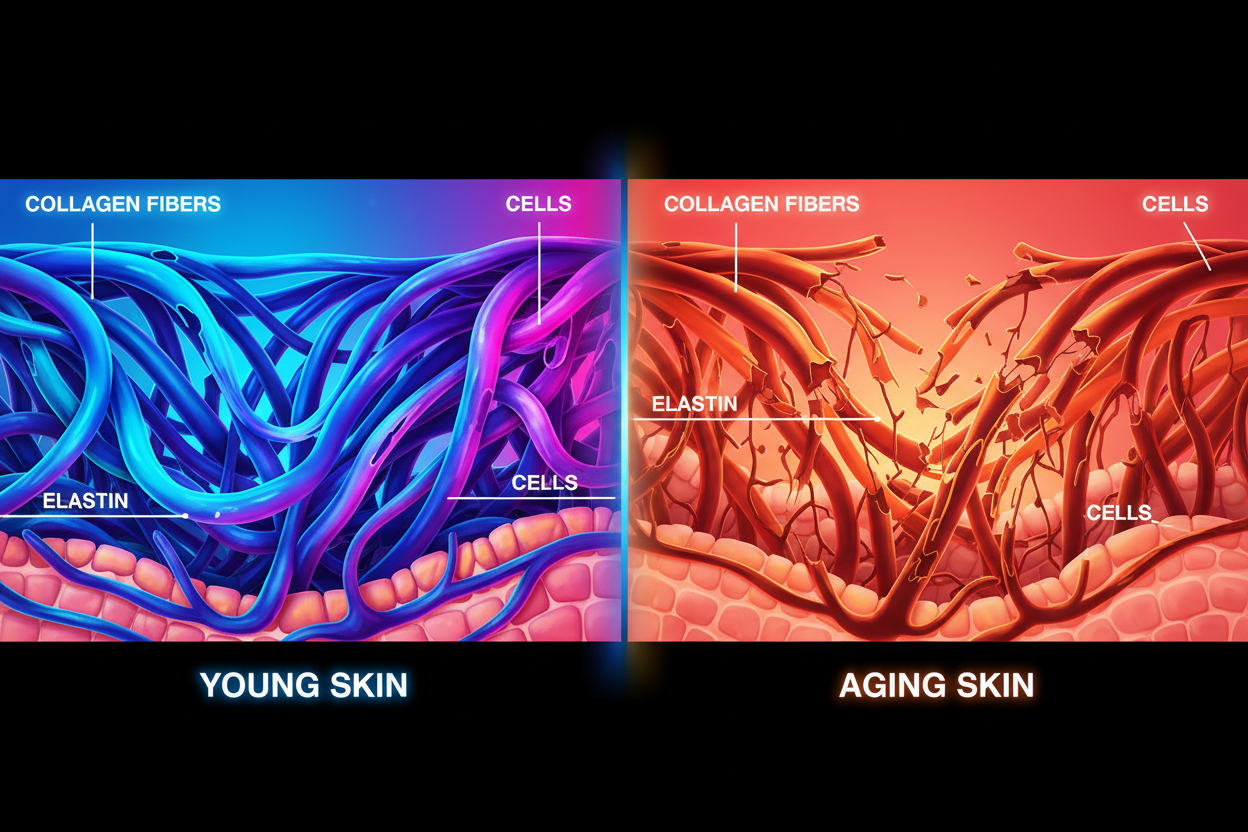
Wrinkles are not surface lines. They are the visible collapse of a deeper support network. In the Southeast Asian climate, where UV indices remain consistently in the extreme range — Singapore regularly records 10–13 on the WHO UV Index — understanding this cellular erosion is the critical first step in moving from reactive “skincare” to proactive cellular health.
The Biophysics of Photon Damage
Why exactly does sunlight destroy skin? It comes down to the energy carried by UV photons. According to the Planck-Einstein relation, a photon's energy (E) is inversely proportional to its wavelength (λ) — the shorter the wavelength, the higher the energy carried per photon.
Because UVA (315–400nm) and UVB (280–315nm) carry extremely short wavelengths, each photon carries enough energy to literally shatter chemical bonds within the dermis — breaking collagen cross-links and initiating the ROS cascade that drives enzymatic destruction.
When these high-energy photons penetrate the dermis, they generate Reactive Oxygen Species (ROS) — unstable free radicals that attack the collagen network directly. When this network is intact, skin maintains its “snap-back” quality (viscoelasticity). When it degrades, the skin sags, creases, and develops the permanent textural changes associated with sun damage.
“The sun does not just tan the skin; it issues a biological command to dissolve the very architecture that keeps it firm.”
The MMP Crisis: The Enzymes That Eat Collagen
The most devastating aspect of UV exposure is the dramatic upregulation of Matrix Metalloproteinases (MMPs). These enzymes exist to facilitate normal tissue remodelling — but UV radiation tricks the skin into massively overproducing them. The result is a destructive cascade.
UV Photons Penetrate the Dermis
UVA (longer wavelength) penetrates to the deep dermis. UVB stays more superficial but carries higher energy per photon. Both generate ROS and activate signalling pathways in keratinocytes and fibroblasts.
MMP-1, MMP-3 & MMP-9 Overproduction
UV signals the overproduction of three key metalloproteinases. MMP-1 (collagenase) cleaves intact collagen fibres. MMP-3 (stromelysin) attacks the extracellular matrix broadly. MMP-9 (gelatinase B) degrades denatured collagen fragments.
Collagen Deficit Develops
The body breaks down collagen at a rate that far exceeds the natural synthesis capacity. Fibroblasts cannot keep up. The deficit compounds with every unprotected UV exposure — daily in Singapore's equatorial climate.
Solar Elastosis — The End State
Chronic, cumulative UV-MMP activity produces solar elastosis: thickened, yellowed, deeply wrinkled skin with poor elasticity and viscoelasticity. This is not natural aging — it is preventable UV-driven structural collapse.
What SPF Is Actually Protecting
Sunscreen is not just blocking burns. At the cellular level, broad-spectrum SPF 50+ is an enzymatic shield preventing MMP overproduction across every UV-exposed session.
- Dermal Matrix Integrity — prevents collagen cross-link destruction
- Fibroblast Cellular Activity — protects ATP-producing mitochondria from ROS
- Structural Elastin Coils — prevents elastin fibre fragmentation
- MMP Enzyme Suppression — no UV signal, no collagenase overproduction
- Long-term Viscoelasticity — the snap-back quality that defines youthful skin
The Clinical Repair Loop: SPF + Red Light Therapy
Once the dermal scaffolding has collapsed, topical creams cannot rebuild it. They have no mechanism to reach the fibroblasts 4–6mm below the skin surface and instruct them to produce new collagen. This is the fundamental limitation of skincare — it cannot address the cellular energy crisis that UV has created.
Low-Level Light Therapy (LLLT) is the reconstruction phase that topicals cannot provide. FDA-cleared 640nm red light penetrates to the dermis and activates Cytochrome c Oxidase in fibroblast mitochondria — triggering ATP production that fuels aggressive collagen and elastin synthesis. Combined, the two interventions form a complete clinical protocol.
🛡️ SPF 50+ — Prevention
Stops ongoing MMP activation by blocking the UV photons that trigger the enzyme cascade. Daily application prevents new collagen loss. The “shield” that keeps the deficit from worsening.
💡 Red Light Therapy — Repair
640nm activates fibroblast mitochondria to produce ATP — fuelling TGFβ signalling for new collagen synthesis. Also shown to modulate MMP expression and boost TIMP (collagen-protecting enzyme) activity. The “rebuild” that reverses the deficit.
Clinical Q&A
Matrix Metalloproteinases (MMPs) are enzymes produced by skin cells in response to UV radiation. MMP-1, MMP-3, and MMP-9 are specifically overproduced during UV exposure and function by breaking down collagen Type I and III in the dermal matrix. The result is a chronic collagen deficit where breakdown far outpaces synthesis — compounding with every unprotected UV exposure until the skin develops the thickened, lined appearance of solar elastosis.
UV causes wrinkles through two mechanisms: (1) Direct photon damage — UVA and UVB photons generate Reactive Oxygen Species that disrupt collagen cross-linking and fragment fibres; (2) MMP activation — UV triggers overproduction of MMP enzymes that actively dissolve collagen and elastin. Together, these create a structural collapse that appears as wrinkles, sagging, and textural deterioration — the visible markers of photoaging.
No. Singapore's UV Index regularly reaches 10–13 (extreme) due to its equatorial proximity. SPF 30 blocks approximately 97% of UVB, leaving a meaningful UV dose that still activates MMPs cumulatively. SPF 50+ is the clinical standard for Singapore and equatorial climates, providing approximately 98% UVB blockage. Critically, choose broad-spectrum SPF covering both UVA and UVB — UVA penetrates deeper and is the primary driver of dermal MMP activation.
Yes, but it requires active support. Red light therapy (640nm) directly addresses the deficit by triggering an ATP surge in fibroblast mitochondria, activating the TGFβ pathway to command aggressive collagen synthesis. Photobiomodulation also modulates MMP expression and boosts TIMP (tissue inhibitor of metalloproteinases) activity — slowing the enzymatic breakdown. Combined with daily SPF 50+ to stop new damage: SPF stops the destruction; LED therapy accelerates the rebuilding.
Solar elastosis is the clinical term for the skin changes caused by chronic cumulative UV exposure — the thickened, yellowed, leathery texture with deep wrinkles and poor snap-back quality. It is distinct from chronological aging; it is accelerated skin degradation caused specifically by UV-driven MMP overproduction destroying the collagen and elastin architecture of the dermis. In Singapore's extreme UV climate, solar elastosis develops faster and earlier than in temperate climates, making proactive SPF and collagen repair essential from an earlier age.
640nm red light repairs UV-damaged skin through two mechanisms: (1) ATP surge — photons activate Cytochrome c Oxidase in fibroblast mitochondria, giving cells the fuel to produce new collagen Type I and III at an accelerated rate; (2) MMP modulation — photobiomodulation reduces MMP expression and promotes TIMP activity, directly slowing enzymatic collagen breakdown. Together these tip the balance from collagen deficit back toward surplus — reversing the structural collapse that UV has created.

留言
此網站已受到 hCaptcha 保護,且適用 hCaptcha 隱私政策以及服務條款。