
What Is Photobiomodulation?
How Red Light Therapy Actually
Works for Collagen, Wrinkles
& Anti-Aging
Photobiomodulation (PBM) is the clinical term for red light therapy. This complete explainer covers how specific wavelengths penetrate tissue, activate mitochondria, trigger collagen and elastin production, and reduce wrinkles — step by step, from photon to clinical outcome.
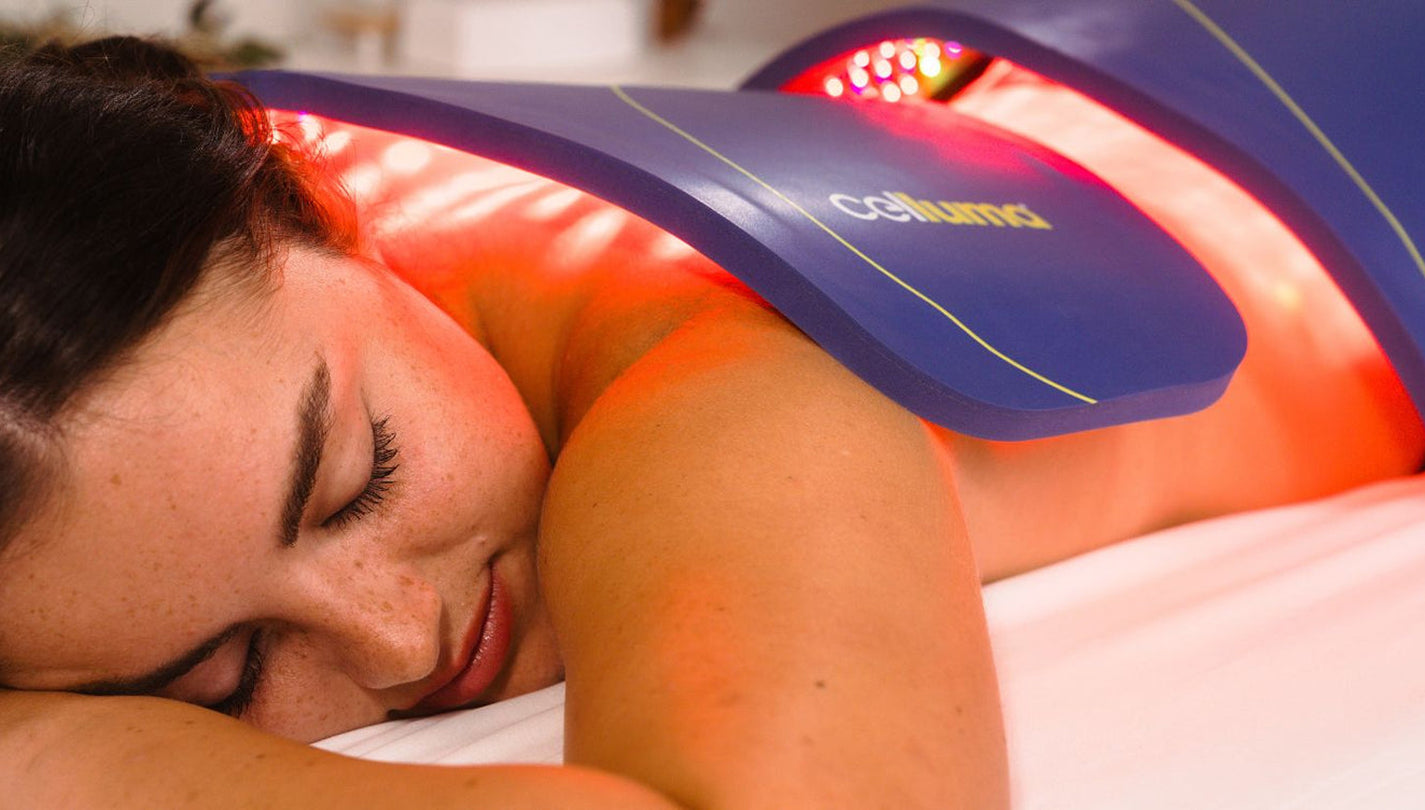
Photobiomodulation (PBM) is the clinical term for red and near-infrared light therapy. Specific wavelengths — primarily 640nm red and 880nm near-infrared — penetrate tissue and are absorbed by Cytochrome c Oxidase in cell mitochondria. This triggers a surge in ATP production that directly powers collagen synthesis, elastin production, wrinkle reduction, inflammation resolution, and tissue repair. It is FDA Class II Cleared — not a wellness gadget, but a clinical intervention with a specific, well-documented molecular mechanism.
We live in an era of topical serums, injectable fillers, and laser resurfacing — all treatments that work at or on the surface of skin. Photobiomodulation works differently. It sends specific wavelengths of light into the tissue, where they are absorbed by the mitochondria inside your cells and converted into cellular energy. The result is not a temporary surface change — it is a restoration of the biological machinery that produces collagen, elastin, and tissue repair at the source. Understanding the mechanism explains both why it works and why device quality matters so much.
What Is Photobiomodulation — and Why Is It Called That?
The word breaks down precisely: photo (light) + bio (biological) + modulation (changing or adjusting). Photobiomodulation means using light to change biological activity. The term replaced earlier names — low-level laser therapy (LLLT), cold laser therapy, low-level light therapy — because it more accurately describes what is happening at the cellular level.
It is not heat therapy. It is not a tanning device. The mechanism is entirely photochemical — specific wavelengths are absorbed by specific molecules in cells (chromophores), triggering chemical reactions that produce cellular energy and activate repair pathways. The light is the catalyst. The cell does the work.
The Optical Window — Why Only Certain Wavelengths Reach Your Cells
Not all light penetrates human tissue. The skin contains chromophores that absorb most of the visible and near-infrared spectrum before it can reach the dermis. Two major blockers define the therapeutic window:
This is why wavelength precision matters so much. A device using 630nm or 950nm loses most of its energy to haemoglobin or water before reaching the fibroblasts, pain receptors, or hair follicles where the therapeutic targets are located. Celluma's 640nm and 880nm are both within the window — calibrated to maximise tissue penetration.
The 3 Clinical Wavelengths and What Each One Does
The Complete Mechanism — From Photon to Collagen and Wrinkle Reduction
This is the precise sequence of molecular events that takes place between a red light photon striking the skin and collagen appearing in the extracellular matrix. Each step is documented in peer-reviewed literature.
Photon Enters the Optical Window
A 640nm photon passes through the epidermis without significant absorption by haemoglobin or water — reaching the dermis 4–6mm below the skin surface where fibroblasts are located.
Absorbed by Cytochrome c Oxidase
The photon is absorbed by Cytochrome c Oxidase (CCO) — the terminal enzyme in the mitochondrial electron transport chain. CCO is the primary chromophore for red and near-infrared PBM. Its absorption spectrum peaks at 640nm and 880nm.
Nitric Oxide Displaced — Electron Transport Chain Unblocked
In stressed or aged cells, inhibitory nitric oxide binds to CCO and blocks the electron transport chain, suppressing ATP output. Light absorption displaces this NO, restoring full ETC function. Oxygen consumption increases. ATP production surges 200–400%.
ATP Powers Collagen, Elastin & Repair
The ATP surge provides the cellular energy for fibroblasts to transcribe collagen genes, assemble peptides, and secrete finished collagen and elastin into the extracellular matrix. DNA repair, hyaluronic acid production, and wound healing also accelerate.
Growth Factor Signalling — Neighbouring Cells Activated
Activated fibroblasts release TGF-β1 and other growth factors that signal neighbouring fibroblasts to also increase collagen production — a paracrine amplification effect that extends the anti-aging response beyond the directly illuminated area.
Inflammation Resolved — Collagen Protected
880nm near-infrared concurrently downregulates pro-inflammatory cytokines and matrix metalloproteinases (MMPs) that degrade newly built collagen. New collagen integrates into the ECM rather than being broken down — producing net collagen gain per session.
The 3 Pillars of Cellular Energy Restored by PBM
Chromophore Absorption
Photons absorbed by Cytochrome c Oxidase displace inhibitory nitric oxide and unblock the electron transport chain — restoring full mitochondrial respiratory function and ATP output.
Mitochondrial Resurgence
The ATP surge provides the cellular fuel for collagen synthesis, elastin production, DNA repair, and tissue regeneration — all processes that decline with age as mitochondrial efficiency falls.
Cytokine Modulation
PBM regulates the inflammatory response — downregulating MMP activity and pro-inflammatory cytokines, shifting cells from an inflammatory state that degrades collagen to an anti-inflammatory state that allows it to rebuild.
Clinical Outcomes: What Photobiomodulation Produces
The same mechanism — photon → CCO → ATP → cellular activation — produces different outcomes depending on which tissue is targeted and which wavelength is used.
Collagen Production
640nm activates fibroblasts to produce collagen Type I and III — rebuilding the structural dermis. FDA-cleared for anti-aging.
Elastin Synthesis
640nm upregulates elastin gene expression — restoring skin's snap-back firmness and reducing sagging from elastin loss with age.
Wrinkle Reduction
As collagen density increases and elastin rebuilds, wrinkle depth measurably reduces. Visible results at 8–12 weeks of daily sessions.
Acne Clearance
465nm blue destroys P. acnes bacteria through photodynamic action. 640nm reduces post-inflammatory redness. Together they treat active acne and prevent breakouts.
Pain Relief
880nm reduces inflammation in muscles, joints, and nerve tissue — providing relief for chronic pain, arthritis and musculoskeletal injuries without medication.
Hair Regrowth
Near-infrared stimulates follicle mitochondria to extend the anagen growth phase — FDA-cleared for androgenetic alopecia.
FDA-Cleared Celluma Devices in Singapore
Frequently Asked Questions
Photobiomodulation is the clinical term for red and near-infrared light therapy. Specific wavelengths (640nm red + 880nm near-infrared) are absorbed by Cytochrome c Oxidase in mitochondria, triggering an ATP surge that powers collagen synthesis, elastin production, inflammation reduction, and tissue repair. It is FDA Class II Cleared — a documented molecular mechanism, not a wellness trend.
640nm red light penetrates the dermis and is absorbed by Cytochrome c Oxidase in fibroblast mitochondria. This displaces inhibitory nitric oxide, unblocking the electron transport chain and producing an ATP surge. The ATP directly powers fibroblasts to produce collagen Type I and III and elastin — reducing wrinkle depth and restoring skin firmness over 8–12 weeks of daily sessions.
640nm red light is the primary anti-aging wavelength — it activates fibroblasts for collagen and elastin production at the dermis level. 880nm near-infrared reduces the inflammation that degrades collagen and penetrates deeper for pain and hair applications. Both fall within the 600–900nm therapeutic optical window.
Cytochrome c Oxidase (CCO) is the terminal enzyme in the mitochondrial electron transport chain — it produces ATP from oxygen. It is also the primary chromophore that absorbs red and near-infrared photons in PBM. When photons activate CCO, they displace inhibitory nitric oxide and restore ATP production. This is the single molecular event from which all photobiomodulation benefits — collagen, elastin, pain relief, hair growth — originate.
The optical window (600–900nm) is the range of wavelengths that penetrate human tissue without being blocked by haemoglobin (below 600nm) or water (above 900nm). Only wavelengths within this window reach the dermis and deeper tissue where fibroblasts, pain receptors, and hair follicles are located. This is why wavelength accuracy matters — devices using 630nm or 950nm lose most energy before reaching their targets.
Yes — photobiomodulation (PBM) is the scientific and clinical term for red and near-infrared light therapy. Other names include low-level laser therapy (LLLT), cold laser therapy, and low-level light therapy. PBM is now the preferred term because it accurately describes the mechanism: photons modulating biological cellular activity. All names refer to the same Cytochrome c Oxidase activation process.
Inflammation reduction at 2 weeks. Measurable collagen increase at 4–6 weeks. Visible wrinkle and firmness improvement at 8–12 weeks. Maximum initial results at 12 weeks of daily 30-minute sessions. Collagen remodelling continues with ongoing use over 6+ months — results are cumulative and compound with consistency.
The same mechanism works at different depths for different targets. 640nm (4–6mm depth): collagen, elastin, wrinkle reduction, acne. 880nm (6–10mm depth): pain relief, joint inflammation, muscle recovery, hair follicle activation. Celluma devices have separate FDA-cleared modes for each indication — same cellular mechanism, different tissue depths and clinical outcomes.
Trust the Science.
Experience Clinical Collagen & Anti-Aging Results.
Explore FDA-cleared Celluma devices — engineered to deliver the correct wavelengths, fluence, and zero-gap contact for clinically proven photobiomodulation outcomes.


Leave a comment
Trang web này được bảo vệ bằng hCaptcha. Ngoài ra, cũng áp dụng Chính sách quyền riêng tư và Điều khoản dịch vụ của hCaptcha.