
Your Red Bulb Is Not
Red Light Therapy.
The Difference Between
Biologically Active &
Biologically Silent Light
A household red LED and a medical-grade therapeutic LED look identical to your eyes. To your cells, they are worlds apart. One produces visual experience. The other initiates a chain of molecular events that repairs tissue, builds collagen, and reduces inflammation. This guide explains exactly where the line is — and why most "red light therapy" devices sold today never cross it.
Most light is biologically silent at the cellular level — including most consumer "red light therapy" devices. For light to trigger photobiomodulation, it must deliver the correct wavelengths (640nm + 880nm) within the therapeutic optical window (600–900nm), at sufficient irradiance (mW/cm²) to reach the dermis, and with zero-gap skin contact to prevent Inverse Square Law energy loss. Without all three, the light is seen by your eyes but ignored by your mitochondria.
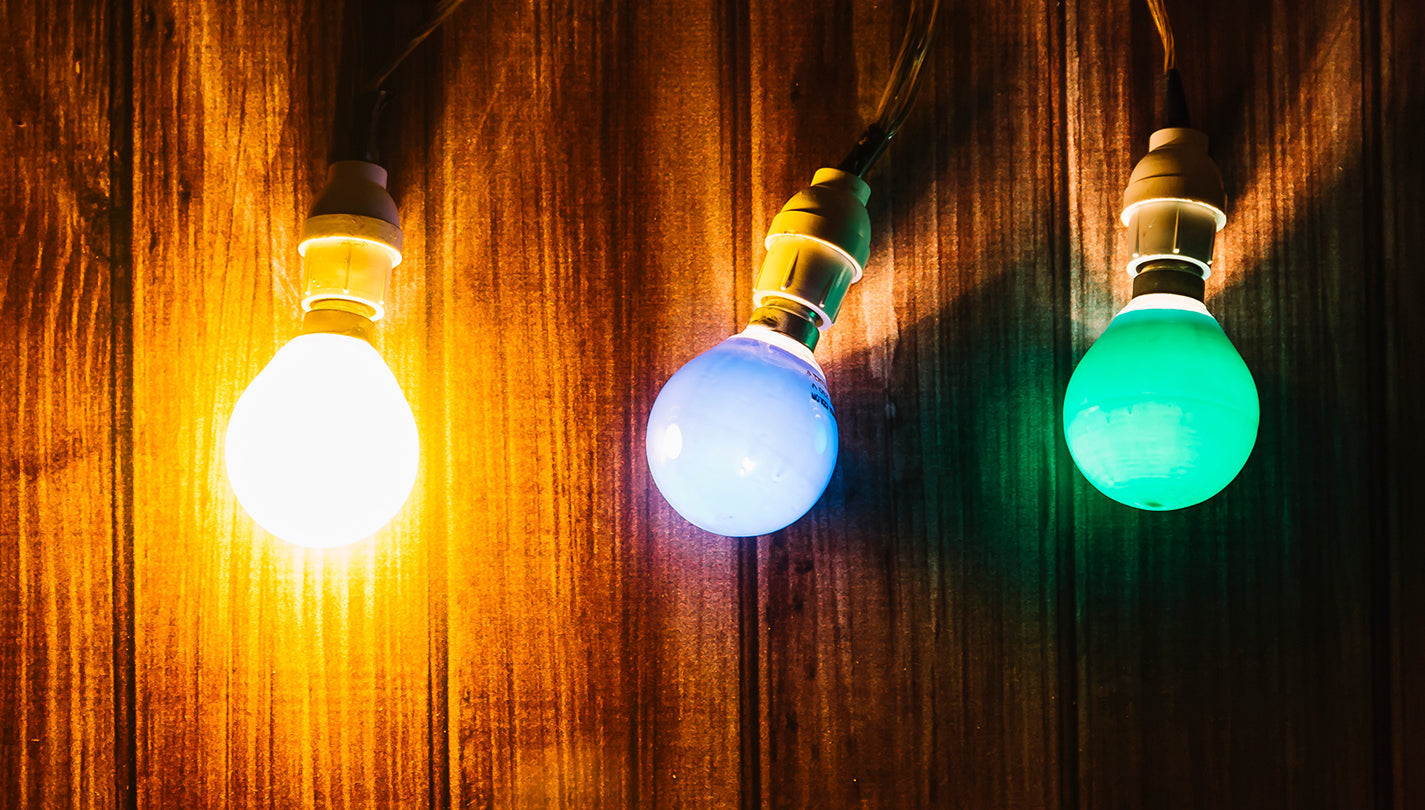
You have been surrounded by red light your entire life — traffic lights, indicator LEDs, decorative lamps, neon signs. None of it has ever repaired your skin, built collagen, or reduced inflammation. Yet red light therapy does all of these things, and the clinical evidence is extensive. The question that almost nobody in the industry answers clearly: what is the actual physical difference between the red light that does nothing and the red light that changes cellular behaviour? The answer comes down to three variables — wavelength, irradiance, and proximity. Understand these, and the entire field of photobiomodulation becomes transparent.
What Makes Light Biologically Silent — The Cellular Perspective
From your mitochondria's perspective, light only matters if it meets one condition: it must be absorbed by Cytochrome c Oxidase (CCO) — the terminal enzyme in the mitochondrial electron transport chain. CCO is the molecular gateway for photobiomodulation. Everything downstream — the ATP surge, the collagen production, the inflammation reduction — depends on this single protein absorbing the incoming photons.
CCO has specific absorption peaks. It responds strongly to approximately 640nm and 880nm. It barely responds to 400nm (violet), 530nm (green), or 700nm (deep red). This is not a preference — it is molecular physics. The chromophore structure of CCO selectively absorbs certain photon energies. Wavelengths outside the therapeutic window are invisible to CCO and produce no photobiomodulation regardless of how bright the light source is.
- Optimised for human retinal response
- Wavelength often unspecified or ~630nm
- No irradiance specification (mW/cm²)
- Absorbed by retina — stops at skin surface
- Biologically silent to Cytochrome c Oxidase
- Calibrated to CCO absorption peaks (640nm + 880nm)
- Specific wavelength tolerance (±5nm)
- Fluence specified in J/cm² per session
- Penetrates dermis to activate mitochondria
- Biologically active — triggers ATP cascade
Lux vs Irradiance — Why the Wrong Metric Tells You Nothing
The confusion between household lighting and therapeutic LED is partly a measurement problem. When people evaluate regular bulbs, they use lux — the photometric unit measuring light as perceived by the human eye. When scientists evaluate photobiomodulation, they use irradiance — the radiometric unit measuring actual photonic power per unit area regardless of how the eye perceives it.
This is why expensive-looking LED face masks can be completely biologically silent. A mask emitting 1,000 lux of broad-spectrum "red" light may produce 0.1 mW/cm² of biologically relevant irradiance at 640nm. A medical-grade device emitting far less visible light may produce 10× the therapeutic irradiance at the precise wavelengths CCO responds to. The consumer sees brightness and assumes efficacy. The biologist measures irradiance and sees the truth.
The Optical Window — Why Only Some Light Reaches Your Cells
Even if a device emits light at the correct wavelength, it must still traverse the skin's optical properties to reach the mitochondria in the dermis. Human tissue is not transparent — it contains chromophores that absorb and scatter light, with two primary blockers defining a narrow therapeutic window.
The Inverse Square Law — Why Any Air Gap Kills Your Results
The third variable is the most physically concrete — and the most commonly violated by rigid LED face masks and tabletop panels. The Inverse Square Law states that the intensity of light decreases with the square of the distance from the source. This is not a guideline — it is a law of physics with no exceptions.
A rigid LED mask sitting 2cm from the skin surface at its cheeks — due to a flat panel not conforming to a three-dimensional face — delivers approximately 25% of its rated irradiance to the dermis. At 5cm (typical for a freestanding panel used at "comfortable distance"), the delivered irradiance is approximately 4% of the headline figure. The device's marketing specification is essentially irrelevant to what the skin actually receives.
How to Tell If a Device Is Biologically Active — 6 Questions to Ask
Wavelength specified to ±5nm
Exact wavelength in nm stated — e.g. 640nm, 880nm. Not "red and infrared" or a range like "620–700nm."
"Red and infrared light" — no nm stated
Wavelength omitted or described vaguely. Cannot verify CCO activation. Likely not optimised for 640nm/880nm peaks.
Irradiance specified in mW/cm²
Photonic power density stated for the treatment surface. FDA devices must specify this. Fluence (J/cm²) per session ideally also provided.
Only watts, lumens, or lux stated
Luminous (vision) units with no irradiance specification. The device has been described in terms irrelevant to photobiomodulation.
Flexible or contoured panel design
Panel is engineered to maintain zero-gap contact with the treatment surface, preventing Inverse Square Law irradiance loss.
Rigid flat panel or plastic shell
Creates air gaps at facial contours. Irradiance at skin surface may be a fraction of the stated specification depending on face geometry.
Maximising Your Biological Yield — Protocol Checklist
Even with a medical-grade device, user behaviour determines how much of the therapeutic irradiance reaches the mitochondria. Two actions significantly affect biological yield every session:
FDA-Cleared Devices Engineered for Biological Activity
Frequently Asked Questions
No. A household red bulb is biologically silent at the cellular level. It produces lux — comfortable for human vision — but lacks the specific wavelength (640nm) and irradiance (mW/cm²) that activates Cytochrome c Oxidase in mitochondria. The photochemical reaction that produces collagen, reduces inflammation, and repairs tissue requires photons that precisely match CCO's absorption peaks. Household LEDs are not calibrated to these peaks.
Illumination (lux) measures light as perceived by the human eye — used for general lighting. Irradiance (mW/cm²) measures photonic power density delivered per unit area of tissue — used in clinical photobiomodulation. Household lighting is optimised for lux. Medical LED therapy is optimised for irradiance at 640nm and 880nm. High lux with wrong wavelength produces zero biological activity. Precise irradiance at the correct wavelength produces measurable cellular change.
Consumer LED masks typically fail three criteria simultaneously: incorrect wavelength (often 630nm or unspecified — not the 640nm CCO peak), insufficient irradiance (sub-therapeutic fluence delivery), and rigid construction creating air gaps at facial contours (Inverse Square Law losses reduce delivered irradiance to a fraction of the specification). A device can appear impressive and still produce no meaningful photobiomodulation in the dermis.
The biologically active wavelengths for collagen and skin anti-aging are 640nm (red) and 880nm (near-infrared) — they match the absorption peaks of Cytochrome c Oxidase and fall within the therapeutic optical window (600–900nm). These wavelengths penetrate the dermis at 4–6mm and 6–10mm respectively. Wavelengths outside this window are blocked by haemoglobin or water before reaching fibroblasts and cannot activate collagen production.
The Inverse Square Law means light intensity falls to one quarter every time distance doubles. A panel rated at 50 mW/cm² at contact delivers ~12 mW/cm² at 2cm, and ~3 mW/cm² at 4cm. Rigid masks create 2–5cm air gaps at facial contours, delivering a fraction of their specification to the dermis. Flexible panels that conform to the face maintain zero-gap contact — ensuring the full rated irradiance reaches mitochondria in the dermis.
Sunscreen (especially zinc oxide and titanium dioxide), thick creams, and oil-based products create a refractive barrier that scatters and reflects incoming photons before they reach the dermis. A layer of SPF50 can reflect or scatter a significant portion of therapeutic photonic energy. The skin must be clean and dry before every session. Apply all skincare products after your session — the post-LED vasodilation window also enhances serum absorption.
Celluma is FDA Class II Cleared with verified 640nm + 880nm wavelengths, a specified fluence of 5.24–7.01 J/cm² per 30-minute session, and a flexible panel that conforms to any body contour for zero-gap contact. These three variables — wavelength precision, calibrated fluence, and zero-gap delivery — are the exact requirements for biological activity. Most consumer devices satisfy none of them to clinical standard.
Ask for: (1) Wavelengths specified in nm — e.g. 640nm, 880nm; (2) Irradiance in mW/cm² — not just watts or lumens; (3) Session fluence in J/cm²; (4) FDA 510(k) Clearance for named indications; (5) Flexible panel design for zero-gap contact. If a brand describes its device only in terms of lux, watts, or colour temperature — those are illumination metrics irrelevant to photobiomodulation.
Stop Watching.
Start Healing.
Celluma delivers clinically calibrated 640nm + 880nm at zero-gap contact — the three variables that separate biologically active light from biologically silent light.



Leave a comment
Trang web này được bảo vệ bằng hCaptcha. Ngoài ra, cũng áp dụng Chính sách quyền riêng tư và Điều khoản dịch vụ của hCaptcha.