
Red Light Therapy for Hair Loss
& Hair Growth:
Does It Actually Work?
The clinical evidence says yes — FDA-cleared, peer-reviewed, and mechanistically specific. This guide explains exactly how red light activates dormant follicles, extends the growth phase, and reverses miniaturisation — with a results timeline, candidate guide, and device recommendations for Singapore.
Yes — red light therapy is FDA-cleared for androgenetic alopecia (pattern hair loss). It works by stimulating Cytochrome c Oxidase in follicle mitochondria, producing an ATP surge that extends the anagen (growth) phase, reverses follicle miniaturisation, and improves scalp blood flow. Multiple randomised controlled trials confirm statistically significant increases in terminal hair density at 16–24 weeks of consistent treatment.
Hair loss is one of the most searched health concerns on Google — and one of the most poorly served by the supplement industry. Biotin gummies and scalp oils address symptoms at the surface. The follicle itself — the root structure that determines whether hair grows or stops — operates on cellular energy and hormonal signalling deep in the dermis. Red light therapy is the only non-invasive treatment that reaches this depth and physically changes what happens inside the follicle.
This is not fringe wellness. It is an FDA-cleared clinical modality backed by randomised controlled trials and a peer-reviewed systematic review published in the Annals of Dermatology. The mechanism is specific and well-understood. Here is the complete explanation.
Understanding the Hair Cycle — Why Phase Determines Density
Every hair follicle cycles independently through three phases. Hair loss occurs when the balance shifts — more follicles in the resting phase, fewer in active growth, and progressive miniaturisation of follicles that remain active.
In androgenetic alopecia (pattern hair loss), DHT (dihydrotestosterone) binds to follicle receptors, progressively shortening the anagen phase and shrinking the follicle itself — a process called miniaturisation. With each cycle, the follicle produces a thinner, shorter hair until eventually producing nothing. Red light therapy interrupts this process at the cellular level.
How Red Light Therapy Activates Follicles — Step by Step
Scalp Penetration — Light Reaches the Follicle
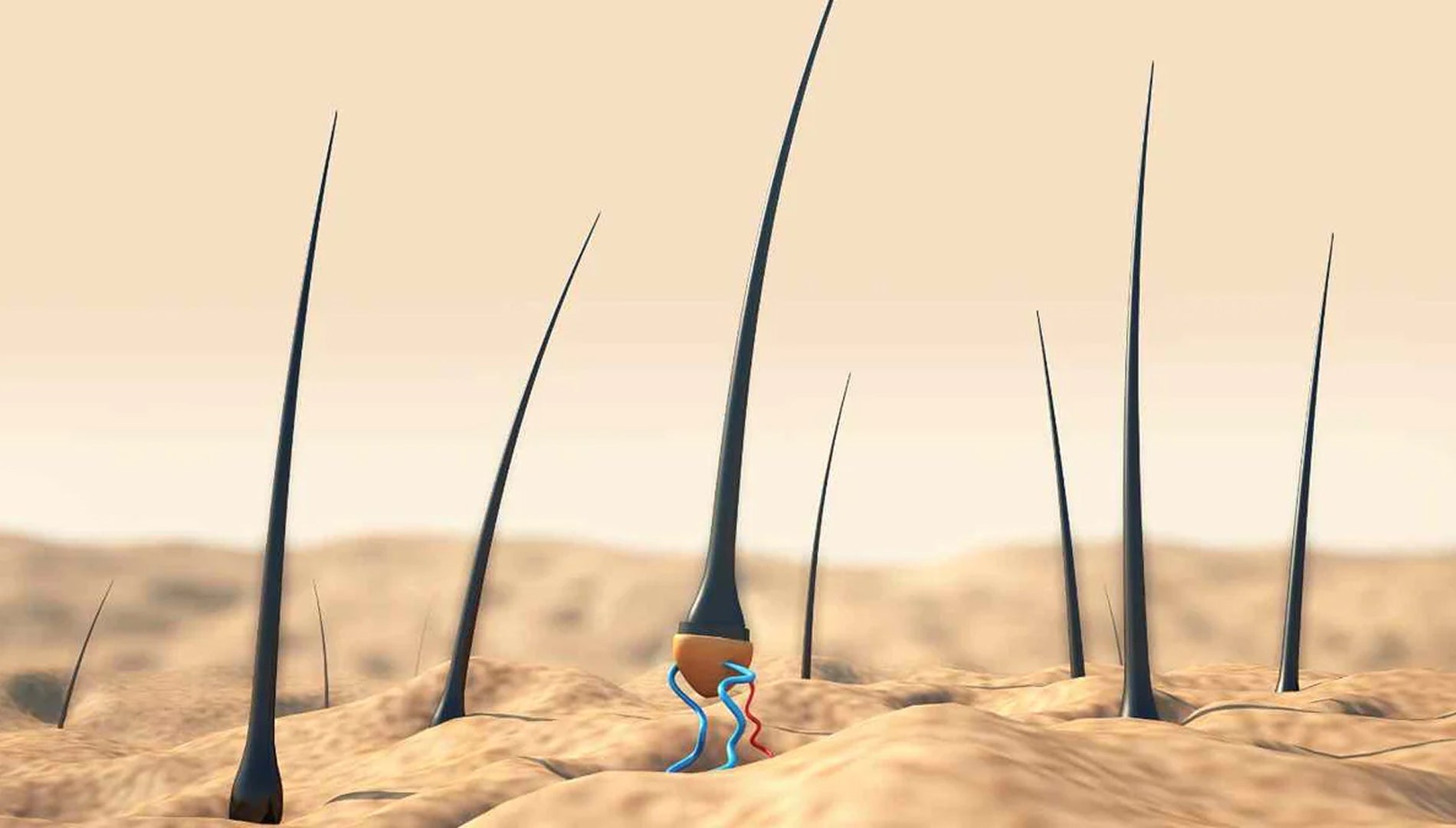
640–670nm red light and 880nm near-infrared penetrate the scalp at a depth sufficient to reach the dermal papilla — the vascular base of the follicle responsible for growth. This is the only non-invasive therapy wavelength range that achieves this depth reliably.
Cytochrome c Oxidase Activation → ATP Surge
Photons are absorbed by Cytochrome c Oxidase in follicle mitochondria. Inhibitory nitric oxide is displaced, unblocking the electron transport chain and producing a 200–400% increase in ATP — the cellular energy driving hair production.
Nitric Oxide Release → Improved Scalp Blood Flow
Concurrently, nitric oxide released by endothelial cells dilates capillaries in the scalp. The dermal papilla receives more oxygen and nutrients — the raw materials the follicle needs to build hair protein (keratin).
Anti-Inflammatory Action → Miniaturisation Halted
DHT-driven hair loss is mediated by pro-inflammatory cytokines (IL-1β, TNF-α) that signal follicle shutdown. Near-infrared (880nm) downregulates these cytokines, interrupting the miniaturisation cascade and allowing follicles to recover their terminal diameter.
Anagen Extension — Growth Phase Lengthens
The ATP-energised follicle sustains longer growth cycles. Studies show a measurable increase in the percentage of follicles in the anagen phase after 12–16 weeks of consistent PBM treatment — directly correlating with increased hair density.
4 Biological Pillars of Photobiomodulation Hair Therapy
ATP Surge
Mitochondrial activation provides the cellular energy required for sustained anagen growth — the direct driver of hair density increase.
Vascular Perfusion
Nitric oxide-driven capillary dilation floods the dermal papilla with nutrients — the building supply chain for hair protein synthesis.
Miniaturisation Reversal
Cytokine modulation halts DHT-mediated follicle shutdown, allowing miniaturised follicles to recover diameter and shaft thickness.
Anagen Phase Extension
Telogen phase shortens; anagen phase extends — shifting the follicle balance from resting-dominant to growth-dominant scalp density.
Red Light Therapy vs Minoxidil vs Finasteride
Understanding what each treatment does — and does not do — helps set realistic expectations and identify the best combination strategy.
| Factor | Minoxidil | Finasteride | Red Light Therapy |
|---|---|---|---|
| Mechanism | Vasodilation (topical) | Blocks DHT production | Follicle ATP + anti-inflammatory |
| FDA Approval | ✓ Hair loss | ✓ Prescription only | ✓ Class II Medical Device |
| Works on Root Cause | ✗ Symptomatic | Partial (DHT) | ✓ Cellular energy + inflammation |
| Side Effects | Irritation, shedding phase | Sexual side effects (men) | None known |
| Prescription Required | OTC available | ✓ Yes | ✗ No prescription |
| Safe for Women | Some formulations | ✗ Generally no | ✓ Yes |
| Maintains Gains After Stopping | ✗ Loss returns | ✗ Loss returns | Better retention with maintenance |
| Best Combined With | All three can be used simultaneously — they work on different pathways and are complementary | ||
Who Is a Good Candidate for Red Light Hair Therapy?
- Early-to-mid pattern hair loss (Norwood I–IV / Ludwig I–II)
- Thinning scalp with miniaturised but still-active follicles
- Women with diffuse thinning (responds very well)
- Post-partum hair shedding recovery
- Those wanting to combine with minoxidil for enhanced results
- Preventive maintenance — slowing ongoing loss
- Advanced pattern loss (Norwood V–VII) — fewer active follicles remain
- Completely bald areas with no follicular activity
- Scarring alopecia — follicles permanently damaged
- Very recent hair loss (<3 months) — early stage, results unpredictable
Hair Regrowth Timeline: What to Expect Week by Week
Hair growth is slow — new terminal hair grows approximately 1.25cm per month. Understanding the biological timeline prevents abandoning treatment before results become visible.
Which Celluma Device for Hair Regrowth?
Three Celluma devices are FDA-cleared for hair regrowth. The choice depends on whether you also want to treat facial skin simultaneously, and your budget.
Frequently Asked Questions
Yes — FDA-cleared for androgenetic alopecia with multiple randomised controlled trials confirming efficacy. Avci et al. (2014) systematic review confirmed statistically significant increases in terminal hair density and thickness after 16–24 weeks. It works by stimulating follicle mitochondria to extend the anagen growth phase and reverse miniaturisation.
Red light (640–670nm) activates Cytochrome c Oxidase in follicle mitochondria, producing an ATP surge that extends the anagen (growth) phase. Near-infrared (880nm) reduces the inflammatory cytokines that cause follicle miniaturisation in DHT-sensitive hair loss. Together they address both the energy deficit and the inflammatory cause of pattern hair loss.
Reduced shedding at 6–8 weeks. New fine hairs visible at 12 weeks. Measurable terminal density increase at 16–20 weeks. Peak clinical results at 24 weeks of consistent 3–5 sessions per week. Hair grows ~1.25cm per month — results are gradual but cumulative.
They are complementary, not competing. Minoxidil dilates surface blood vessels; red light activates follicle cellular energy and reduces inflammation. Combined use is consistently more effective than either alone. Red light therapy has no known side effects, requires no prescription, and is safe for both men and women — advantages minoxidil does not share.
The RESTORE II (from SGD 1,880) is the dedicated scalp device — flexible panel placed directly on the scalp. The MYSTIQUE (from SGD 1,400) treats face and scalp simultaneously via an integrated scalp arm. The NOVA (from SGD 2,380) is cordless with 5 modes including hair. All are FDA-cleared for androgenetic alopecia.
Red light therapy works on miniaturised but still-active follicles — thinning areas where follicles are present but underperforming. Completely bald scalp with no remaining follicular activity responds poorly. Early intervention produces the best outcomes — start when thinning is visible, not when loss is extensive.
Yes — completely safe for daily use. FDA-cleared Celluma devices are non-thermal and non-invasive. They do not heat the scalp, damage hair shafts, or interfere with follicle structure. No prescription required, no medication interactions, no recovery time. Safe for both men and women including those with colour-treated hair.
FDA-cleared Celluma devices for hair regrowth are available through Celluma Asia with free island-wide delivery and ready stocks. Home devices allow daily sessions — more consistent and far more cost-effective than clinic visits. WhatsApp +65 9446 8877 for a device recommendation based on your hair loss pattern and budget.
Activate Your Follicles.
Restore Your Density.
Explore FDA-cleared Celluma devices for hair regrowth — or WhatsApp our clinical team for a personalised recommendation based on your hair loss pattern and stage.


Leave a comment
เว็บไซต์นี้ได้รับการคุ้มครองโดย hCaptcha และมีการนำนโยบายความเป็นส่วนตัวของ hCaptcha และข้อกำหนดในการใช้บริการมาใช้