
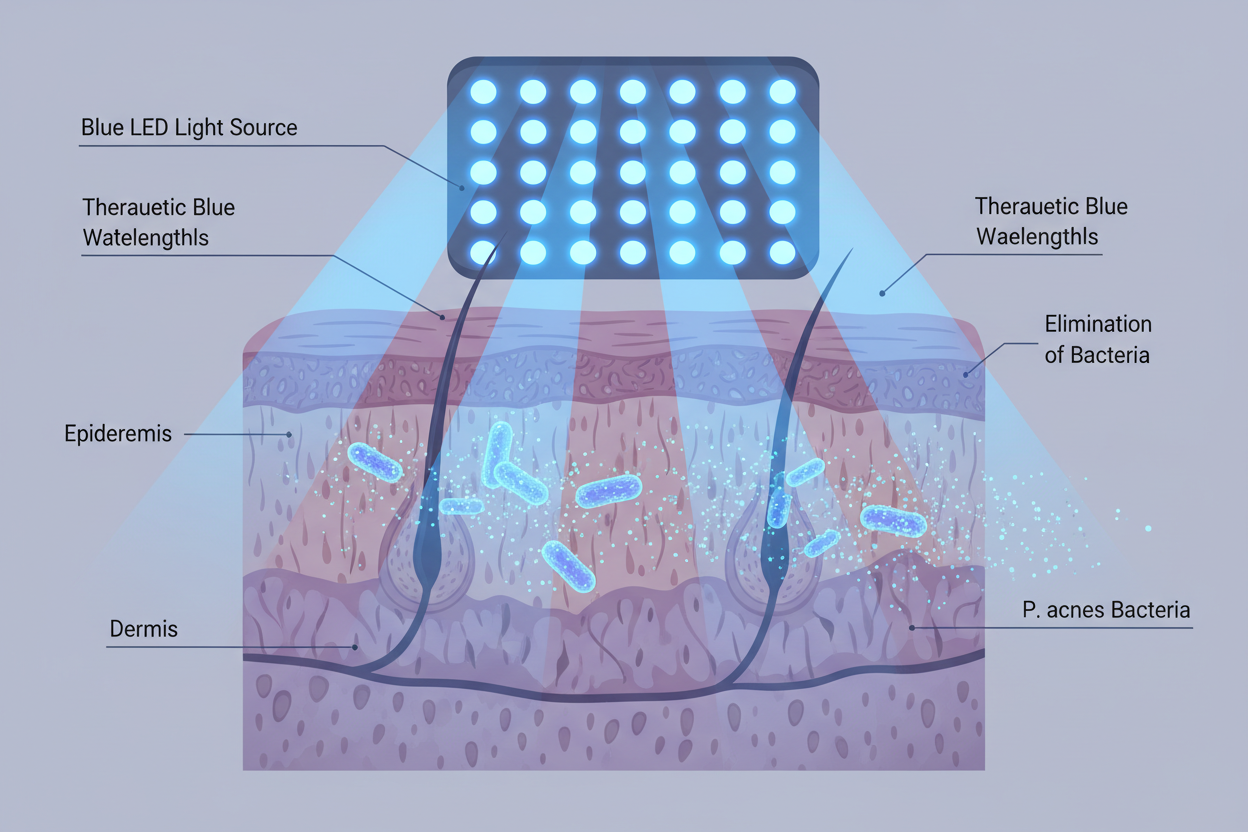
Blue light therapy at 465nm destroys P. acnes by exciting endogenous porphyrins inside the bacteria, triggering a photodynamic reaction that generates Singlet Oxygen (¹O₂) — which oxidises and ruptures the bacterial cell wall from within. Combined with 640nm red light to reduce the inflammatory cytokine response, Celluma's FDA-cleared dual-wavelength acne protocol addresses both the infection and the inflammation simultaneously.
1. Targeting the Pathogen: P. acnes
In Singapore's humid tropical climate — with average temperatures of 26–32°C and high year-round humidity — Propionibacterium acnes (P. acnes) finds optimal conditions for proliferation inside sebaceous follicles. Increased sweat and sebum production accelerate bacterial colonisation, making inflammatory acne a particularly persistent concern in the region.
Celluma offers a targeted non-pharmaceutical alternative that eliminates bacteria without generating antibiotic resistance, disrupting the gut microbiome, or stripping the skin's natural moisture barrier — concerns associated with long-term topical and oral antibiotic acne therapies.
✗ Antibiotic Approach
- ✗Generates antibiotic-resistant strains
- ✗Disrupts gut microbiome
- ✗Systemic side effects
- ✗Photosensitivity risk in SG climate
✓ Blue Light Therapy
- ✓Zero antibiotic resistance possible
- ✓Gut microbiome unaffected
- ✓No systemic side effects
- ✓Safe in high-UV Singapore environment
2. The Mechanism: Intracellular Singlet Oxygen
The efficacy of blue light therapy for acne lies in exploiting the bacteria's own metabolic chemistry against itself. P. acnes produces porphyrins as metabolic byproducts — and these porphyrins act as endogenous light-sensitisers:
Porphyrins inside P. acnes absorb 465nm blue light photons and enter a highly excited singlet or triplet energy state.
This excitation reacts with molecular oxygen present in the tissue, generating highly reactive Singlet Oxygen (¹O₂) inside the bacterial cell.
Internal oxidative damage causes immediate cell wall destruction. Healthy human tissue — which does not contain bacterial porphyrins — is left completely intact.
Why this is selective: The Singlet Oxygen generation only occurs where porphyrins are present — inside P. acnes specifically. Human skin cells do not produce bacterial porphyrins, so the photodynamic reaction is precisely targeted to the pathogen without a heat or thermal mechanism that could damage surrounding tissue.
3. The Red-Blue Synergy
Blue light alone addresses the bacterial cause of acne. But inflammatory acne also involves an immune response that drives the painful, swollen nodules and the post-acne redness that lingers for weeks. Adding 640nm red light treats both dimensions simultaneously:
🔬 The Dual-Wavelength Acne Protocol
Bacterial Extinction
Porphyrin excitation → Singlet Oxygen → P. acnes cell wall destruction
Inflammation Reduction
Reduces IL-1α and pro-inflammatory cytokines. Soothes painful nodular inflammation.
Sebum + Healing
Balances sebaceous activity. Accelerates healing of post-acne erythema (red marks).
4. Protocol for Sustainable Clearance
3–4 sessions per week, 30 minutes each. The protocol follows three phases:
| Phase | Clinical Objective | Expected Outcome |
|---|---|---|
|
Weeks 1–4 Active Treatment |
Aggressive suppression of P. acnes population. Reduction in active nodule count and severity. | 30–50% lesion reduction |
|
Weeks 4–8 Balancing Phase |
Sebaceous balancing to prevent bacterial regrowth. Healing of post-acne erythema (red marks). | Reduced redness + oiliness |
|
Week 12+ Maintenance |
Long-term prevention of cystic outbreaks. 1–2 sessions per week sustained indefinitely. | Clear skin maintained |
Acne & Blue Light Therapy Q&A
465nm blue light is absorbed by porphyrins — endogenous metabolic byproducts of P. acnes bacteria. This triggers a photodynamic reaction generating Singlet Oxygen (¹O₂) inside the bacterial cell, causing immediate oxidative cell wall destruction. Healthy human skin tissue is left intact because it does not produce bacterial porphyrins.
Yes. It is non-thermal, selective to porphyrin-containing bacteria, does not generate antibiotic resistance, and does not strip the moisture barrier. Celluma is FDA Class II cleared for acne and safe for all skin tones including Fitzpatrick types IV–VI common in Singapore.
Meaningful reduction in active lesions typically within 2–4 weeks at 3–4 sessions per week. Sebaceous balancing and erythema healing in weeks 4–8. Long-term prevention from week 12 at 1–2 sessions per week. Results compound because the photodynamic mechanism generates no bacterial resistance.
Yes — this is the recommended approach. 465nm blue destroys bacteria; 640nm red simultaneously reduces pro-inflammatory cytokines (IL-1α), regulates sebum production, and accelerates healing of post-acne erythema. Celluma's acne mode delivers both wavelengths simultaneously.
Blue light offers key advantages: zero antibiotic resistance, no gut microbiome disruption, no systemic side effects, and no photosensitivity risks in Singapore's UV environment. For mild to moderate inflammatory acne it is highly effective as a standalone non-pharmaceutical intervention. For severe cystic acne it is often combined with dermatological treatment.
Singapore's tropical climate (26–32°C, high humidity, UV Index 10–13 year-round) creates ideal conditions for P. acnes proliferation. Blue light therapy addresses the bacterial infection without photosensitivity risks associated with some topical acne treatments that interact with intense UV. Celluma is safe for Fitzpatrick types IV–VI skin tones common in the region.
Clear Skin. No Antibiotics. No Resistance.
FDA-cleared blue light therapy for acne — available for home use in Singapore with free island-wide delivery.
Scientific Resources

Leave a comment
เว็บไซต์นี้ได้รับการคุ้มครองโดย hCaptcha และมีการนำนโยบายความเป็นส่วนตัวของ hCaptcha และข้อกำหนดในการใช้บริการมาใช้