
Why Proximity Is the
Core of Clinical Efficacy.
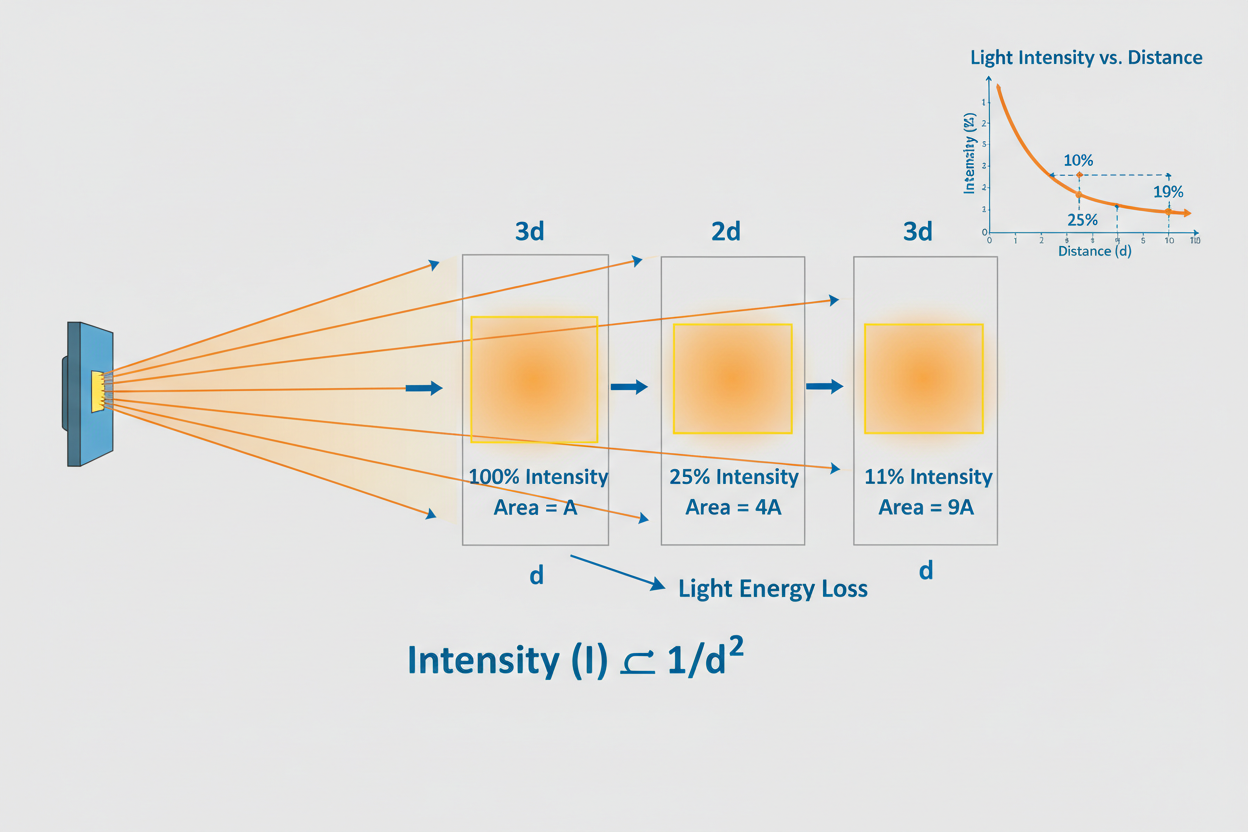
Zero distance is the clinical standard. The Inverse Square Law means light intensity drops with the square of distance from the source. At just 1 inch (2.5cm) from the skin, irradiance is already significantly reduced. At 4 inches, it may fall below the biological threshold for photochemical response. Celluma's flexible panel eliminates the air gap entirely — maintaining clinical irradiance at the skin surface regardless of facial or body contours.
In Photobiomodulation (PBM), proximity is the primary driver of biological change. Due to the Inverse Square Law, light intensity dissipates rapidly over distance. Celluma's patented flexible design eliminates the “air gap,” ensuring maximal photon absorption and the energy density required to reach the biological threshold for tissue repair.
1. The Fallacy of High-Power Irradiance Specs
Many LED device manufacturers market based on irradiance (mW/cm²) measured strictly at the source — the LED surface itself. For a clinician or informed consumer, this metric is misleading. The only specification that determines clinical outcome is the Total Delivered Energy (Joules/cm²) that successfully reaches the target mitochondria at skin depth.
A device rated at 200mW/cm² operated at 4 inches from the skin may deliver less therapeutic energy than a 50mW/cm² device in direct contact. The physics are unambiguous: irradiance drops with the square of distance. Every centimetre of air gap between panel and skin is a direct reduction in therapeutic dose.
What Happens to Energy at Different Distances
The Inverse Square Law applies with immediate practical consequence. Doubling the distance from the skin reduces irradiance to one-quarter of its value. Tripling the distance reduces it to one-ninth. The chart below shows the approximate energy retained at the skin surface at increasing distances from a panel that delivers 100% at contact.
Contact (0mm)
100% Energy TransferFull irradiance at the tissue surface. Cytochrome c Oxidase receives the photon dose required for ATP surge. Cellular saturation is achieved.
1 Inch (2.5cm) Gap
Significant ScatteringIntensity drops sharply as photons dissipate in air. Common in rigid masks over curved areas — cheekbones, jaw, forehead.
4 Inch (10cm) Gap
Sub-TherapeuticEnergy falls below the threshold required for biological signalling. Typical of freestanding panels used at recommended “safe” distances.
2. Eliminating the Air Gap — Why Celluma's Flexible Panel Changes Everything
To trigger a structural response in the skin — whether collagen synthesis in fibroblasts or ATP production for pain relief — the tissue must receive sufficient energy to reach Cellular Saturation. This threshold is approximately 4–6 J/cm² for anti-aging applications and 6–10 J/cm² for pain indications.
Rigid LED panels fail precisely where the skin curves away from the flat surface. Consider the anatomy: a rigid mask sits flat, but your cheekbones protrude, your nose rises, your jawline angles. The areas where the skin is closest to the panel receive a reasonable dose. The areas where the face curves away — often the areas with the most visible aging — receive a fraction of the therapeutic dose, or none at all.
| Physics Metric | Celluma (Flexible) | Rigid LED Panels |
|---|---|---|
| Panel-to-Skin Contact | Zero-gap · Full contact | Fixed distance · Air gaps on curves |
| Irradiance at Tissue | 100% of rated source output | 20–60% depending on anatomy |
| Photon Scattering | Eliminated at contact surface | High — increases with curve |
| Energy Delivery on Curves | Uniform across all contours | Drops sharply at cheeks, jaw, forehead |
| Therapeutic Dose Achieved | Consistent every session | Variable — depends on positioning |
| FDA Clearance Basis | Proximity design reviewed | Often registered only, not cleared |
Clinical Conclusion
In clinical practice, “Power” is a vanity metric if it cannot be delivered to the tissue. A device rated at 200mW/cm² that operates from a 4-inch distance may be less therapeutic than a 60mW/cm² device in zero-gap contact. Prioritise devices that enable direct skin contact and maintain that contact across curved anatomy. Proximity is not a preference — it is the physical requirement that separates devices that produce results from devices that produce a glow.
Frequently Asked Questions
Zero distance — direct contact is the clinical standard. The Inverse Square Law means irradiance drops with the square of distance. At just 2.5cm (1 inch) from skin, energy delivery is already reduced to roughly 40% of contact levels. At 10cm (4 inches), it may fall as low as 6% — well below the biological threshold for photochemical response. For therapeutic results, the LED panel must be in direct contact with the skin surface at all times during treatment.
For clinical therapeutic effect, yes. The energy density (fluence) required to activate Cytochrome c Oxidase and trigger an ATP surge must meet a specific threshold — approximately 4–6 J/cm² for anti-aging and 6–10 J/cm² for pain. This threshold is only reliably achieved when the device is in direct contact with skin, eliminating the air gap and ensuring every photon contributes to the therapeutic dose rather than dissipating in air.
The Inverse Square Law states that light intensity is inversely proportional to the square of distance from the source (E = I∕d²). In practical terms: doubling the distance reduces irradiance to one-quarter; tripling the distance reduces it to one-ninth. This is why source-level irradiance specs are misleading — only irradiance measured at the skin surface during actual use predicts clinical outcome. Manufacturers who do not specify measurement distance are giving you a meaningless number.
Rigid panels create air gaps where the skin curves away — cheekbones, jawline, nose, forehead. Due to the Inverse Square Law, these gaps cause significant energy loss in the exact areas where most visible aging occurs. Celluma's patented flexible panel conforms directly to skin contours, maintaining zero-gap contact and full irradiance delivery across every facial or body curve. The result: uniform therapeutic dosing across the entire treatment area, not just the flat zones closest to the panel.
Because source power is irrelevant if it cannot be delivered to the tissue. A 200mW/cm² device at 4 inches may deliver less than a 50mW/cm² device in direct contact. The only metric that predicts clinical outcomes is Total Delivered Energy at the tissue surface (Joules/cm²) — not rated output. High-power specs with poor delivery geometry (rigid panels, fixed distances) produce sub-therapeutic results despite impressive numbers on the product listing.
Cellular saturation is the biological threshold at which sufficient photon energy has been delivered to Cytochrome c Oxidase in the mitochondria to trigger a photochemical response — the ATP surge that drives tissue repair, collagen synthesis, and inflammation reduction. Thresholds are typically 4–6 J/cm² for anti-aging and 6–10 J/cm² for pain applications. If irradiance at the skin surface falls below these thresholds due to distance or air gaps, no lasting biological effect occurs regardless of session duration.
Disclaimer: Technical data is based on established photobiological principles and the Inverse Square Law of physics. Consult a medical professional for specific clinical protocols. © 2026 Celluma Asia | Clinical Phototherapy & Dermal Science

Leave a comment
Laman ini dilindungi oleh hCaptcha dan tertakluk pada Dasar Privasi dan Terma Perkhidmatan hCaptcha.