

Does Red Light Therapy Actually Work
for Wrinkles, Collagen & Anti-Aging?
The Clinical Fact-Check
Red light therapy is clinically proven for collagen production, elastin synthesis, and wrinkle reduction — but only when the device meets four specific requirements most consumer LED masks fail. This guide explains the evidence, the failures, and how to tell a real medical device from a cosmetic gadget.
Yes — red light therapy is clinically proven for wrinkle reduction, collagen production, and elastin synthesis. Over 5,000 peer-reviewed studies confirm the mechanism. The confusion arises because the market is dominated by cheap consumer LED masks that violate the four optical laws that make photobiomodulation work. FDA-cleared medical devices that meet all four criteria produce consistent, measurable anti-aging results. Consumer gadgets typically meet none.
The number of people who have tried a red light LED mask and felt nothing is large. They bought a device that promised collagen production, wrinkle reduction, and anti-aging results. They used it daily. Nothing happened. They concluded red light therapy doesn't work. The conclusion is wrong — but it's understandable. The consumer LED market is almost entirely populated by devices that are physically incapable of producing photobiomodulation, regardless of how they're marketed. Understanding the four requirements that make red light therapy work immediately explains both the clinical evidence and the widespread consumer disappointment.
Why Most LED Masks Fail to Produce Collagen or Reduce Wrinkles
Consumer LED masks fail for predictable, measurable reasons — not because the therapy is ineffective, but because the devices don't meet the biophysical requirements for photobiomodulation to occur. Here are the two most common failure modes, and what they mean for your collagen and elastin results:
Many consumer masks use 630nm or broad-spectrum red LEDs because they're cheaper. The photoreceptor that drives collagen and elastin production — Cytochrome c Oxidase — has peak absorption at 640nm and 880nm. Wavelengths outside the 600–900nm optical window are largely reflected by skin or absorbed by water before reaching the dermis. Your fibroblasts receive little to no activation.
Rigid LED masks create air gaps at the cheeks, chin, nose, and forehead. Due to the Inverse Square Law, even 3–4cm of air between LED and skin reduces irradiance to a fraction of the rated output. A mask rated at 50 mW/cm² at contact may deliver as little as 3–5 mW/cm² at 3cm. This is often below the therapeutic threshold for collagen stimulation entirely.
The total energy dose (fluence, measured in J/cm²) determines whether fibroblasts are activated for collagen and elastin synthesis. Consumer masks with low irradiance and short session times (5–10 minutes marketed as convenient) frequently deliver sub-therapeutic fluence — not enough energy to trigger a meaningful repair response.
Most consumer LED masks are "FDA registered" — meaning only the manufacturing facility is listed. This says nothing about the device's safety or anti-aging efficacy. Without FDA 510(k) clearance for specific indications, there is no independent verification that the device produces clinically measurable collagen, elastin, or wrinkle outcomes.
The 4 Optical Laws That Determine Whether Red Light Works for Anti-Aging
Every clinical study that confirms red light therapy produces collagen, reduces wrinkles, or rebuilds elastin was conducted with a device meeting all four of these requirements simultaneously. Remove any one, and results decline sharply. Remove multiple, and you have the average consumer LED mask.
640nm + 880nm — No Substitutes
Cytochrome c Oxidase — the fibroblast enzyme that drives collagen and elastin production — absorbs specifically at these wavelengths. Red at 640nm activates dermal fibroblasts. Near-infrared at 880nm reduces inflammation that degrades newly built collagen.
Celluma: ✓ Both wavelengths calibrated2–6 J/cm² per Session for Skin
Fluence (J/cm²) = [Irradiance × Time] ÷ 1,000. This total energy dose — not peak power — is the variable that determines collagen and elastin synthesis rate. Clinical trials define all skin anti-aging outcomes by fluence, not irradiance.
Celluma: ✓ 5.24–7.01 J/cm² per 30-min sessionZero-Gap Contact — Non-Negotiable
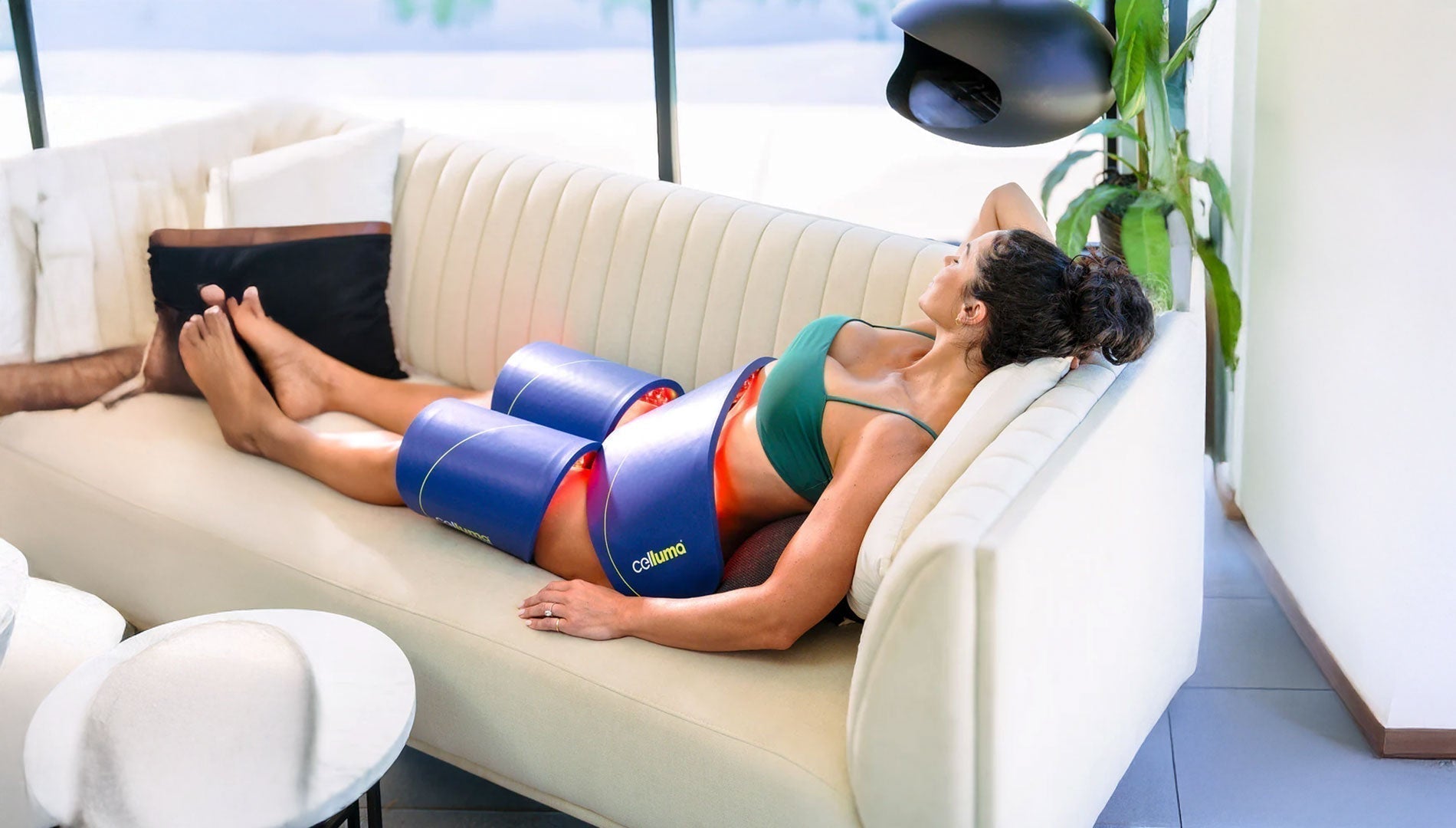
Double the distance → irradiance drops to one quarter. Any air gap between panel and skin significantly reduces the energy reaching the dermis. Flexible panels that conform to the face maintain full irradiance contact across every contour — rigid masks do not.
Celluma: ✓ Flexible shape-taking panel30 Minutes — Not 5
Fibroblast collagen synthesis requires sustained ATP activation to complete the biphasic dose-response and initiate gene transcription. 5-minute high-power sessions either underdose or overdose (biphasic inhibition). 30 minutes at calibrated irradiance consistently lands in the therapeutic window.
Celluma: ✓ 30-minute auto-shutoff protocolFDA Cleared vs FDA Registered — The Most Important Distinction in LED Devices
This is the single most overlooked distinction in the LED therapy market. Every LED manufacturer can claim "FDA" in their marketing — the term is almost meaningless without the specific classification that follows it.
- No independent review of efficacy
- No verification of collagen or anti-aging claims
- No clinical testing required
- Any manufacturer can register a facility
- Cosmetic devices — no medical indications
- Independently reviewed by FDA
- Cleared for named indications (acne, wrinkles, pain)
- Clinical evidence requirement
- Safety profile audited
- Medical device — not cosmetic gadget
Medical-Grade vs Consumer LED — Side by Side
| Factor | Typical Consumer LED Mask | Celluma Medical Device |
|---|---|---|
| Wavelength Accuracy | Often 630nm or unspecified | ✓ 640nm + 880nm exact |
| FDA Status | Registered only (facility) | ✓ 510(k) Cleared (device) |
| Cleared for Wrinkles / Collagen | ✗ | ✓ Named clinical indication |
| Cleared for Elastin / Anti-Aging | ✗ | ✓ |
| Panel Contact with Skin | Rigid — air gaps reduce irradiance | Flexible — zero-gap contact |
| Fluence per Session (J/cm²) | Often sub-therapeutic or unknown | 5.24–7.01 J/cm² (calibrated) |
| Recommended Session Length | Often 5–15 min (underdoses) | 30 minutes (clinical standard) |
| Peer-Reviewed Evidence | Device-specific studies absent | ✓ Multiple clinical trials |
| Price | SGD 50–500 | SGD 1,280–3,100 |
The Anti-Aging LED Buyer's Checklist — 6 Things to Verify Before You Buy
Ask these six questions before purchasing any LED device for anti-aging, collagen, or wrinkles:
- FDA 510(k) Clearance — not just registered
- Cleared for wrinkles/anti-aging specifically
- Wavelength: 640nm red + 880nm NIR
- Flexible panel for zero-gap skin contact
- Fluence spec: 2–6 J/cm² per 30-min session
- Published peer-reviewed clinical evidence cited
FDA-Cleared LED Devices for Anti-Aging & Collagen in Singapore
All three devices below hold FDA 510(k) Clearance for anti-aging (wrinkle reduction) and produce clinically validated collagen and elastin results.
Frequently Asked Questions
Yes — FDA-cleared red light therapy is clinically proven for wrinkle reduction, collagen production, and elastin synthesis. The therapy only works when the device uses correct wavelengths (640nm + 880nm), delivers adequate fluence (2–6 J/cm²), runs for 30-minute sessions, and maintains zero-gap skin contact. Consumer LED masks frequently fail all four requirements — which explains the widespread "it didn't work for me" experience.
The most common reasons: wrong wavelength (consumer masks often use 630nm, not the clinical 640nm that activates fibroblasts); rigid panel creating air gaps (Inverse Square Law reduces irradiance to a fraction at even small distances); insufficient fluence (sub-therapeutic total energy from low irradiance and short sessions); and no FDA clearance (no independent verification the device produces collagen or anti-aging results).
No. Photobiomodulation has over 5,000 peer-reviewed studies confirming collagen production, wrinkle reduction, elastin synthesis, pain relief, and hair regrowth. The confusion is that cheap consumer LED gadgets — which dominate the market — don't work. FDA Class II cleared medical devices like Celluma produce clinically measurable results. The therapy is real; device quality is the variable.
FDA Registered means only the manufacturer's facility is listed — it says nothing about the device's safety or efficacy. FDA 510(k) Cleared means the device was independently reviewed and found safe and effective for specific medical indications. Celluma is FDA Class II Cleared specifically for wrinkle reduction, acne, and pain — the FDA has independently confirmed its anti-aging and collagen efficacy.
640nm red light is the primary wavelength for collagen and elastin production — it activates Cytochrome c Oxidase in dermal fibroblasts. 880nm near-infrared reduces inflammation that degrades collagen. Both are required for maximum anti-aging and wrinkle results. Most consumer masks use 630nm or unspecified "red" wavelengths that don't efficiently activate this pathway.
The Inverse Square Law: doubling the distance between the LED and skin reduces irradiance to one quarter. Rigid face masks leave air gaps at cheeks, chin, and forehead — even 3–4cm reduces delivered irradiance to a fraction of the rated spec. Flexible panels like Celluma conform to face contours, maintaining zero-gap contact so full rated irradiance reaches the dermis where fibroblasts produce collagen and elastin.
Check for: (1) FDA 510(k) Clearance for specific indications — not just registration; (2) named indications (wrinkles, acne, pain); (3) exact wavelengths — 640nm and 880nm; (4) fluence specification in J/cm²; (5) flexible panel design for zero-gap contact; (6) published peer-reviewed clinical evidence. Celluma meets all six criteria as an FDA Class II Medical Device.
Four requirements must all be met: (1) 640nm + 880nm wavelengths to activate Cytochrome c Oxidase in fibroblast mitochondria; (2) 2–6 J/cm² fluence per session for collagen and elastin gene expression; (3) 30-minute duration for the full biphasic dose-response to develop; (4) zero-gap contact via a flexible panel to prevent Inverse Square Law loss. Medical-grade devices are engineered to meet all four simultaneously.
Experience the Science
of True Collagen & Anti-Aging Results.
Explore FDA-cleared Celluma devices — engineered to meet all four optical laws for clinically proven collagen, elastin, and wrinkle results.


Leave a comment
Laman ini dilindungi oleh hCaptcha dan tertakluk pada Dasar Privasi dan Terma Perkhidmatan hCaptcha.