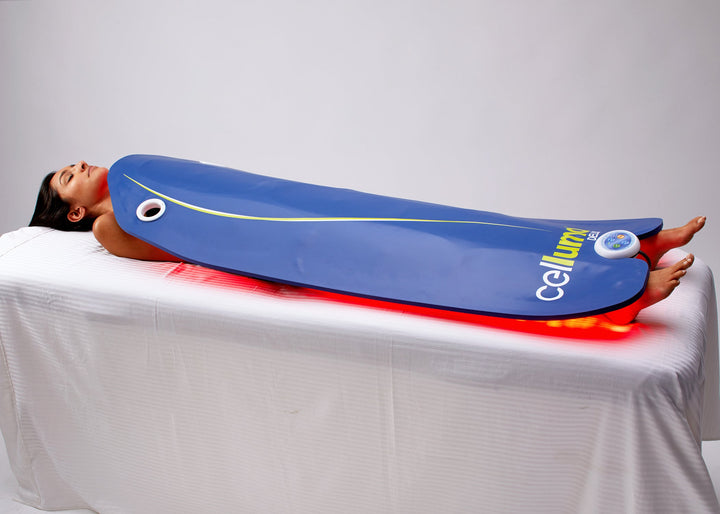
Featured image: Image from the Celluma collection.
The Celluma Journal · Updated
A wavelength tells you the colour or spectral region of light, not the complete performance of a therapy device. A useful specification also explains treatment area, output at the intended distance and the recommended programme. Read those details together to compare devices meaningfully.
Wavelength: the type of light
Wavelength is usually listed in nanometres, abbreviated nm. Red light is visible; near-infrared lies beyond the visible red range. Blue light occupies a different part of the spectrum and is used in some acne programmes. Each spectral region interacts with tissue differently.
LEDs emit across a band around their stated peak. A peak specification should not be read as a single perfectly isolated wavelength. Nor does a small difference in the stated peak establish that one device works and another cannot. Clinical LED studies have used several wavelength combinations, including the red and near-infrared settings in a clinical skin study.
Irradiance: light power reaching an area
Irradiance is commonly shown in milliwatts per square centimetre. Ask where and how it was measured. A value at the light source, a value at the recommended treatment distance and an average across a panel can be different measurements.
Coverage also matters. A strong central reading does not explain the whole treatment area. When comparing specifications, look for conditions that match how the device is intended to be used. Avoid judging by visible brightness, electrical wattage or LED count alone.
Fluence: energy delivered over time
Fluence, or radiant exposure, is commonly reported in joules per square centimetre. For a constant measured irradiance, multiplying power per area by exposure time gives energy per area, with the appropriate unit conversion. Pulsed programmes require attention to average output rather than simply using the peak value.
This calculation describes exposure; it does not generate a personal treatment prescription. Two protocols with the same nominal fluence can differ in wavelength, duration, geometry and biological effect. The intended application and tested conditions remain essential.
Distance: part of the measurement
The working distance affects how a device illuminates the treatment area. A large array of many LEDs is not the same geometry as an ideal point source. Simple inverse-square diagrams should therefore not be used to invent universal percentages for every mask and panel.
Use the recommended position rather than calculating a new distance from a marketing graphic. The Celluma Series 2 panel manual, for example, describes close placement with room for air circulation. Our distance guide discusses the practical setup in more detail.
Evidence: what those numbers were used to achieve
A specification is most useful when connected to an intended outcome. Was the protocol studied for wrinkles, acne or another concern? Did it use the same device or a relevant configuration? What course was followed, and what result was actually measured?
Mechanism research helps explain why light may influence tissue. Human studies show what a particular treatment achieved under particular conditions. Use both to connect the specifications with the outcome you want, then check that the device's intended application and instructions match that goal.
A short comparison checklist
- Identify the exact device and intended application.
- Note the wavelength bands and the treatment area.
- Check the measurement conditions for any irradiance claim.
- Read the programme duration and positioning instructions.
- Look for relevant clinical and regulatory documentation.
- Decide whether the format fits your routine.
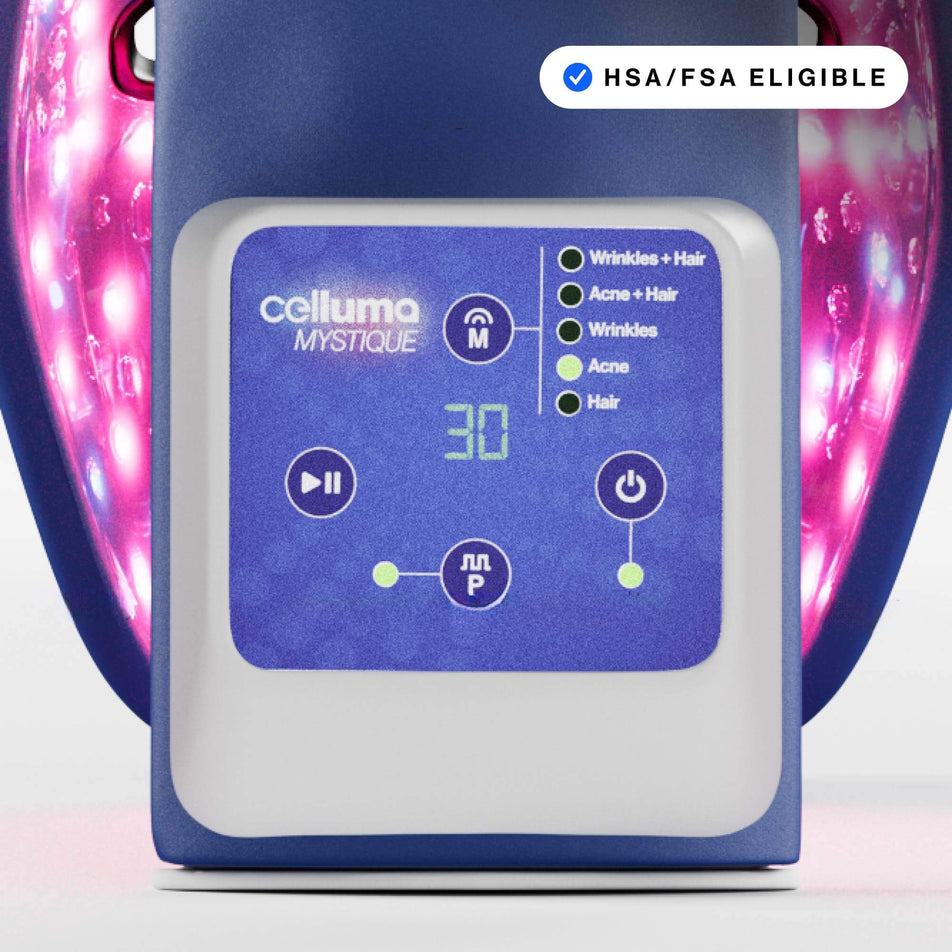
Celluma's selectable modes make this practical: you choose the named programme and follow its instructions rather than calculating a dose yourself. Compare PRO II with other formats through Celluma Asia, and use the buyer's guide to connect the technical details with your goals.
Frequently asked questions
What does nm mean on an LED device?
Nanometres describe wavelength. The number helps identify the light’s spectral region, but does not state its treatment area, delivered energy or effectiveness by itself.
Can I compare two irradiance numbers directly?
Only when the measurement conditions are comparable. Check distance, measurement area and whether a number is peak or average output.
Does a higher fluence mean a better treatment?
Not automatically. A suitable dose depends on the application and complete protocol. Follow the device instructions rather than chasing the largest energy value.
Should I use an online formula to change my session?
Use formulas to understand specifications, not to replace a validated programme. Your current model manual should guide session time and positioning.